


Ch. 21 - Carboxylic Acid Derivatives
Wade - Organic Chemistry 9th Edition
Wade9th EditionOrganic ChemistryISBN: 9780135213728당신이 사용하는 게 아니라요?교과서 변경
21장, 문제 54d

Show how you would accomplish the following syntheses. Some of these conversions may require more than one step.
(d) ethyl acetate → 3-methylpentan-3-ol

검증된 단계별 안내
1
Identify the starting material (ethyl acetate) and the target product (3-methylpentan-3-ol). Ethyl acetate is an ester, and the target compound is a tertiary alcohol. This suggests that the synthesis will involve a Grignard reaction, as Grignard reagents are commonly used to form tertiary alcohols.
Prepare the Grignard reagent needed for the reaction. To form 3-methylpentan-3-ol, the Grignard reagent should be derived from 2-methylpropyl bromide (CH₃)₂CHCH₂Br. React this alkyl halide with magnesium (Mg) in dry ether to form the Grignard reagent (CH₃)₂CHCH₂MgBr.
React the Grignard reagent (CH₃)₂CHCH₂MgBr with ethyl acetate (CH₃COOCH₂CH₃). The Grignard reagent will attack the carbonyl carbon of the ester, leading to the formation of a ketone intermediate (3-methylpentan-2-one).
Add a second equivalent of the Grignard reagent (CH₃)₂CHCH₂MgBr to the ketone intermediate (3-methylpentan-2-one). This will result in the formation of a tertiary alcohol after the addition reaction.
Perform an acidic workup (e.g., using H₃O⁺) to protonate the alkoxide intermediate and obtain the final product, 3-methylpentan-3-ol.

비슷한 문제에 대한 검증된 영상 답변:

이 영상 해법은 위 문제에 도움이 된다고 튜터들이 추천한 것입니다.
영상 길이:
4m

주요 개념

질문에 올바르게 답하기 위해 반드시 이해해야 하는 핵심 개념들은 다음과 같습니다.

Nucleophilic Substitution

Nucleophilic substitution is a fundamental reaction in organic chemistry where a nucleophile attacks an electrophile, resulting in the replacement of a leaving group. In the synthesis of 3-methylpentan-3-ol from ethyl acetate, understanding how nucleophiles can displace groups is crucial for planning the reaction steps.
추천 영상:
01:47
Nucleophiles and Electrophiles can react in Substitution Reactions.

Grignard Reagents

Grignard reagents are organomagnesium compounds that act as strong nucleophiles, allowing for the formation of carbon-carbon bonds. In this synthesis, a Grignard reagent can be used to add a carbon chain to the carbonyl carbon of an intermediate, facilitating the conversion of ethyl acetate to the desired alcohol.
추천 영상:
02:12
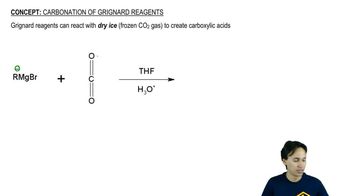
Carbonation of Grignard Reagents

Functional Group Interconversion

Functional group interconversion refers to the transformation of one functional group into another, which is often necessary in multi-step syntheses. In the conversion of ethyl acetate to 3-methylpentan-3-ol, it is essential to understand how to manipulate functional groups, such as converting esters to alcohols, to achieve the final product.
추천 영상:
02:36
Identifying Functional Groups