

Ch. 21 - Carboxylic Acid Derivatives
Wade - Organic Chemistry 9th Edition
Wade9th EditionOrganic ChemistryISBN: 9780135213728당신이 사용하는 게 아니라요?교과서 변경
21장, 문제 38b

Show how you would convert the following starting materials to the indicated nitriles:
(b) phenylacetic acid → 3-phenylpropionitrile

검증된 단계별 안내
1
Step 1: Begin by understanding the transformation required. The starting material is phenylacetic acid (C₆H₅CH₂COOH), and the target product is 3-phenylpropionitrile (C₆H₅CH₂CH₂CN). This involves replacing the carboxylic acid (-COOH) group with a nitrile (-CN) group while extending the carbon chain by one methylene (-CH₂-) group.
Step 2: Convert phenylacetic acid into phenylacetyl chloride (C₆H₅CH₂COCl) using thionyl chloride (SOCl₂). This reaction replaces the hydroxyl group (-OH) of the carboxylic acid with a chlorine atom, forming an acyl chloride. The reaction proceeds via nucleophilic substitution.
Step 3: Perform a reaction with ammonia (NH₃) to convert phenylacetyl chloride into phenylacetamide (C₆H₅CH₂CONH₂). Ammonia acts as a nucleophile, attacking the acyl chloride to form the amide. This step introduces the nitrogen atom required for the nitrile group.
Step 4: Subject phenylacetamide to dehydration using a dehydrating agent such as phosphorus pentoxide (P₂O₅) or thionyl chloride (SOCl₂). This step removes water from the amide, converting it into phenylacetonitrile (C₆H₅CH₂CN).
Step 5: Perform a homologation reaction to extend the carbon chain by one methylene group. React phenylacetonitrile with sodium cyanide (NaCN) and an alkyl halide, such as ethyl bromide (C₂H₅Br), under basic conditions. This introduces the additional -CH₂- group, yielding 3-phenylpropionitrile (C₆H₅CH₂CH₂CN).

비슷한 문제에 대한 검증된 영상 답변:

이 영상 해법은 위 문제에 도움이 된다고 튜터들이 추천한 것입니다.
영상 길이:
3m

주요 개념

질문에 올바르게 답하기 위해 반드시 이해해야 하는 핵심 개념들은 다음과 같습니다.

Nitrile Synthesis

Nitriles are organic compounds containing a cyano group (-C≡N). One common method to synthesize nitriles is through the conversion of carboxylic acids or their derivatives. In this case, phenylacetic acid can be transformed into a nitrile by first converting it to an acid chloride and then reacting it with a suitable nucleophile, such as sodium cyanide.
추천 영상:
가이드 코스
0:59
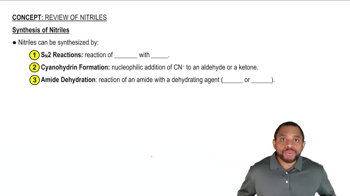
Review of Nitriles Concept 1

Reagents and Reaction Conditions

The choice of reagents and reaction conditions is crucial in organic synthesis. For converting phenylacetic acid to 3-phenylpropionitrile, reagents like thionyl chloride (SOCl2) or oxalyl chloride (COCl) can be used to form the acid chloride. Following this, a nucleophilic substitution reaction with sodium cyanide will yield the desired nitrile product.
추천 영상:
01:52
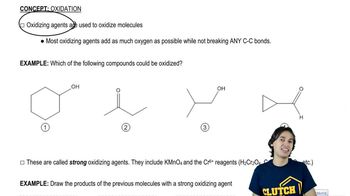
Reagents

Mechanism of Nucleophilic Substitution

Nucleophilic substitution reactions involve the attack of a nucleophile on an electrophile, leading to the replacement of a leaving group. In the case of converting an acid chloride to a nitrile, the cyanide ion acts as the nucleophile, attacking the carbonyl carbon of the acid chloride, resulting in the formation of the nitrile while releasing chloride ions as a byproduct.
추천 영상:
01:47
Nucleophiles and Electrophiles can react in Substitution Reactions.