Ch. 22 - Condensations and Alpha Substitutions of Carbonyl Compounds
Wade - Organic Chemistry 9th Edition
Wade9th EditionOrganic ChemistryISBN: 9780135213728당신이 사용하는 게 아니라요?교과서 변경
22장, 문제 3d

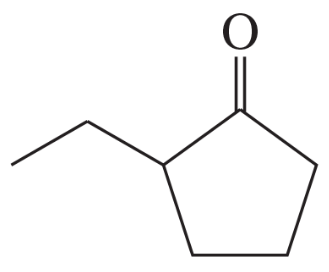
Give the important resonance forms for the possible enolate ions of the following:
(d)

검증된 단계별 안내
1
Identify the alpha hydrogens in the molecule. Alpha hydrogens are the hydrogens attached to the carbon atoms adjacent to the carbonyl group. In this case, the alpha carbons are the ones directly connected to the carbonyl carbon.
Determine the possible enolate ions that can form by deprotonating the alpha hydrogens. Deprotonation leads to the formation of a carbanion at the alpha carbon, which is stabilized by resonance with the carbonyl group.
Draw the resonance structures for each enolate ion. The negative charge on the alpha carbon can delocalize onto the oxygen atom of the carbonyl group, forming a resonance structure where the oxygen has a negative charge and the alpha carbon has a double bond with the carbonyl carbon.
Consider the stereochemistry and structure of the molecule. The molecule has two distinct alpha carbons (one on the cyclopentane ring and one on the ethyl group). Each alpha carbon can form its own enolate ion, and each enolate ion will have its own set of resonance structures.
Ensure that all resonance structures obey the rules of resonance, such as maintaining the octet rule for all atoms involved and properly delocalizing the electrons. Label the resonance structures to show the movement of electrons and the stabilization of the enolate ion.

비슷한 문제에 대한 검증된 영상 답변:

이 영상 해법은 위 문제에 도움이 된다고 튜터들이 추천한 것입니다.
영상 길이:
1m

주요 개념

질문에 올바르게 답하기 위해 반드시 이해해야 하는 핵심 개념들은 다음과 같습니다.

Enolate Ions

Enolate ions are reactive intermediates formed from the deprotonation of a carbonyl compound, typically a ketone or aldehyde. They contain a negatively charged carbon atom adjacent to a carbonyl group, which allows for resonance stabilization. This resonance can lead to different structural forms, influencing the reactivity and stability of the enolate in various organic reactions.
추천 영상:
02:26
Formation of Enolates

Resonance Structures

Resonance structures are different Lewis structures for the same molecule that depict the delocalization of electrons. In the case of enolate ions, resonance allows the negative charge to be shared between the carbon atom and the oxygen atom of the carbonyl group. This delocalization stabilizes the enolate ion and is crucial for understanding its reactivity in nucleophilic addition and other reactions.
추천 영상:
03:04
Drawing Resonance Structures

Carbonyl Compounds

Carbonyl compounds, characterized by the presence of a carbon-oxygen double bond (C=O), include aldehydes, ketones, and carboxylic acids. They are key substrates in organic chemistry, particularly in reactions involving enolate ions. Understanding the structure and reactivity of carbonyl compounds is essential for predicting the behavior of enolates and their resonance forms in various chemical transformations.
추천 영상:
01:40
Defining meso compounds.