Ch. 22 - Condensations and Alpha Substitutions of Carbonyl Compounds
Wade - Organic Chemistry 9th Edition
Wade9th EditionOrganic ChemistryISBN: 9780135213728당신이 사용하는 게 아니라요?교과서 변경
22장, 문제 1a,b

Phenylacetone can form two different enols.
(a) Show the structures of these enols.
(b) Predict which enol will be present in the larger concentration at equilibrium.

검증된 단계별 안내
1
Step 1: Understand the structure of phenylacetone. Phenylacetone is a ketone with the structure C6H5-CH2-CO-CH3. It contains an alpha-carbon (the carbon adjacent to the carbonyl group) with hydrogens that can be deprotonated to form enols.
Step 2: Identify the possible enols. Enols are formed by the keto-enol tautomerization process, where a proton is transferred from the alpha-carbon to the oxygen of the carbonyl group, resulting in a double bond between the alpha-carbon and the carbonyl carbon. For phenylacetone, there are two alpha-carbons: one adjacent to the phenyl group and one adjacent to the methyl group. Draw the two possible enol structures: (1) enol with the double bond between the phenyl group and the carbonyl carbon, and (2) enol with the double bond between the methyl group and the carbonyl carbon.
Step 3: Analyze the stability of the enols. The stability of enols is influenced by factors such as conjugation and hydrogen bonding. The enol with the double bond adjacent to the phenyl group will benefit from conjugation with the aromatic ring, which stabilizes the structure. The enol with the double bond adjacent to the methyl group does not have this stabilization.
Step 4: Predict the equilibrium distribution. At equilibrium, the more stable enol will be present in a larger concentration. Since the enol with the double bond adjacent to the phenyl group is stabilized by conjugation, it is expected to be the predominant enol at equilibrium.
Step 5: Summarize the findings. The two enols of phenylacetone are (1) the enol with the double bond adjacent to the phenyl group and (2) the enol with the double bond adjacent to the methyl group. The enol with the double bond adjacent to the phenyl group will be present in a larger concentration at equilibrium due to its greater stability from conjugation with the aromatic ring.

비슷한 문제에 대한 검증된 영상 답변:

이 영상 해법은 위 문제에 도움이 된다고 튜터들이 추천한 것입니다.
영상 길이:
2m

주요 개념

질문에 올바르게 답하기 위해 반드시 이해해야 하는 핵심 개념들은 다음과 같습니다.

Enol Tautomerism

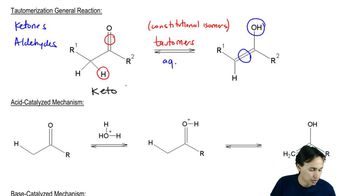
Enol tautomerism is a chemical equilibrium between a keto form and its corresponding enol form. In this process, a hydrogen atom shifts from the carbon adjacent to the carbonyl group to the carbonyl carbon, resulting in the formation of an alkene with a hydroxyl group. Understanding this concept is crucial for predicting the structures of enols formed from phenylacetone.
추천 영상:
05:11
Tautomerization Mechanisms

Stability of Enols

The stability of enols is influenced by factors such as sterics, electronic effects, and resonance. Enols that can stabilize their double bond through resonance or that are less sterically hindered tend to be more stable and thus present in higher concentrations at equilibrium. Analyzing these factors helps in predicting which enol will dominate in phenylacetone.
추천 영상:
02:26
Formation of Enolates

Equilibrium Concentration

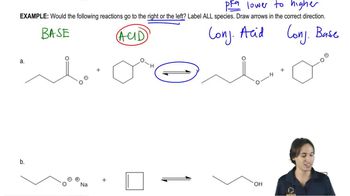
Equilibrium concentration refers to the relative amounts of reactants and products present in a chemical reaction at equilibrium. In the context of enols, the concentration of each enol at equilibrium can be predicted by considering their relative stabilities. The more stable enol will generally be favored, leading to a higher concentration compared to the less stable form.
추천 영상:
04:00
Determining Acid/Base Equilibrium