Ch. 22 - Condensations and Alpha Substitutions of Carbonyl Compounds
Wade - Organic Chemistry 9th Edition
Wade9th EditionOrganic ChemistryISBN: 9780135213728당신이 사용하는 게 아니라요?교과서 변경
22장, 문제 69b

Predict the products of the following reactions.
(b) 1-phenylethanol + excess I2 in base

검증된 단계별 안내
1
Step 1: Recognize the reactants and reaction conditions. The reactants are 1-phenylethanol (Ph-CH(OH)-CH3) and excess iodine (I2) in a basic medium (OH⁻). This is a classic example of the haloform reaction.
Step 2: Understand the mechanism of the haloform reaction. In the presence of excess iodine and base, the methyl group attached to the alcohol is oxidized to a ketone (acetophenone, Ph-CO-CH3). The methyl group is then further converted into a trihalomethyl group (CCl3 or CI3) and subsequently cleaved to form a haloform (CHI3, iodoform).
Step 3: Analyze the intermediate steps. The alcohol group (-OH) is first oxidized to a ketone (acetophenone). Then, the methyl group adjacent to the carbonyl undergoes successive halogenation to form a trihalomethyl group (-CI3).
Step 4: Predict the cleavage products. The trihalomethyl group is cleaved in the presence of base, yielding iodoform (CHI3) and a carboxylate ion (Ph-COO⁻).
Step 5: Summarize the final products. The reaction produces iodoform (CHI3), which is a yellow precipitate, and sodium benzoate (Ph-COO⁻Na⁺) as the carboxylate salt in the basic medium.

비슷한 문제에 대한 검증된 영상 답변:

이 영상 해법은 위 문제에 도움이 된다고 튜터들이 추천한 것입니다.
영상 길이:
7m

주요 개념

질문에 올바르게 답하기 위해 반드시 이해해야 하는 핵심 개념들은 다음과 같습니다.

Nucleophilic Substitution

Nucleophilic substitution is a fundamental reaction mechanism in organic chemistry where a nucleophile attacks an electrophile, resulting in the replacement of a leaving group. In the context of 1-phenylethanol reacting with iodine in a basic medium, the hydroxyl group (-OH) can be converted into a better leaving group, facilitating the substitution reaction with iodine.
추천 영상:
01:47
Nucleophiles and Electrophiles can react in Substitution Reactions.

Oxidation-Reduction Reactions

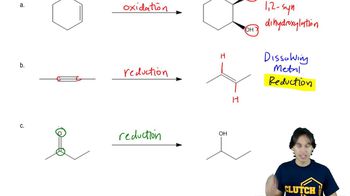
Oxidation-reduction (redox) reactions involve the transfer of electrons between species, leading to changes in oxidation states. In the reaction of 1-phenylethanol with iodine, the alcohol can undergo oxidation to form a carbonyl compound, while iodine is reduced. Understanding these changes is crucial for predicting the products of the reaction.
추천 영상:
00:54
Distinguishing between Oxidation and Reduction

Iodination of Alcohols

Iodination of alcohols is a specific reaction where iodine reacts with alcohols in the presence of a base, often leading to the formation of iodoalkanes. In this case, the excess iodine reacts with the hydroxyl group of 1-phenylethanol, resulting in the formation of an iodo derivative. Recognizing the conditions and mechanisms of iodination is essential for predicting the final products.
추천 영상:
01:01
How to name alcohols