Ch. 22 - Condensations and Alpha Substitutions of Carbonyl Compounds
Wade - Organic Chemistry 9th Edition
Wade9th EditionOrganic ChemistryISBN: 9780135213728당신이 사용하는 게 아니라요?교과서 변경
22장, 문제 69f

Predict the products of the following reactions.
(f)

검증된 단계별 안내
1
Step 1: Analyze the starting material, which is a cyclic anhydride. Cyclic anhydrides are reactive compounds that can undergo nucleophilic attack at the carbonyl carbon.
Step 2: The first reagent, CH3ONa (sodium methoxide), acts as a nucleophile. It will attack one of the carbonyl carbons in the anhydride, leading to the opening of the ring and formation of a carboxylate group and an ester group.
Step 3: The second reagent, CH3CH2CH2Br (1-bromopropane), is an alkyl halide. It will react with the carboxylate group formed in the previous step via an SN2 mechanism, replacing the bromine atom with the alkyl group.
Step 4: The final product will consist of an ester group and a carboxylic acid derivative where the alkyl group from the alkyl halide has been added.
Step 5: Ensure stereochemistry and regiochemistry are considered, if applicable, during the SN2 reaction. The product will be a substituted ester and carboxylic acid derivative.

비슷한 문제에 대한 검증된 영상 답변:

이 영상 해법은 위 문제에 도움이 된다고 튜터들이 추천한 것입니다.
영상 길이:
1m

주요 개념

질문에 올바르게 답하기 위해 반드시 이해해야 하는 핵심 개념들은 다음과 같습니다.

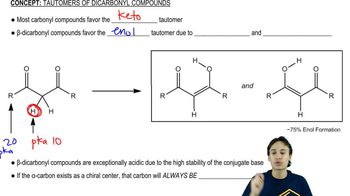
Beta-Dicarbonyl Compounds

Beta-dicarbonyl compounds are organic molecules containing two carbonyl groups (C=O) separated by a single carbon atom. These compounds are important in organic synthesis due to their reactivity, particularly in nucleophilic addition reactions. The presence of two carbonyls enhances acidity and allows for enolate formation, which can be further reacted with alkyl halides to form larger carbon chains.
추천 영상:
04:48
Tautomers of Dicarbonyls

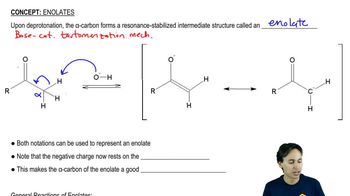
Enolate Formation

Enolate formation occurs when a base abstracts a proton from the alpha carbon of a carbonyl compound, resulting in a resonance-stabilized anion. In this reaction, CH3ONa acts as a strong base, deprotonating the beta-dicarbonyl compound to generate an enolate. This enolate can then act as a nucleophile, attacking an electrophile such as an alkyl halide, facilitating carbon chain elongation.
추천 영상:
02:26
Formation of Enolates

Nucleophilic Substitution Reactions

Nucleophilic substitution reactions involve the replacement of a leaving group in a molecule by a nucleophile. In this case, the enolate formed from the beta-dicarbonyl compound acts as the nucleophile, attacking the alkyl bromide. This reaction typically follows either an SN2 mechanism, where the nucleophile attacks the electrophile in a single step, or an SN1 mechanism, depending on the structure of the alkyl halide and reaction conditions.
추천 영상:
01:47
Nucleophiles and Electrophiles can react in Substitution Reactions.