Ch. 22 - Condensations and Alpha Substitutions of Carbonyl Compounds
Wade - Organic Chemistry 9th Edition
Wade9th EditionOrganic ChemistryISBN: 9780135213728당신이 사용하는 게 아니라요?교과서 변경
22장, 문제 70

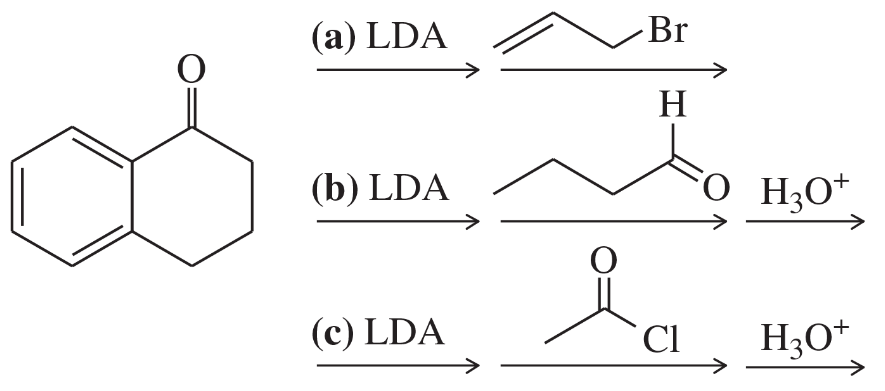
Predict the products of these reaction sequences.

검증된 단계별 안내
1
Step 1: Analyze the reaction conditions for each sequence. LDA (Lithium Diisopropylamide) is a strong, non-nucleophilic base used to deprotonate the most acidic hydrogen, typically forming an enolate intermediate. H3O+ is used to quench the reaction and protonate intermediates.
Step 2: For reaction sequence A, the ketone in the cyclic compound is deprotonated by LDA to form an enolate. The enolate then reacts with the acyl chloride via nucleophilic acyl substitution, forming a new ketone product. The H3O+ step ensures the reaction is completed and intermediates are protonated.
Step 3: For reaction sequence B, LDA deprotonates the cyclic ketone to form an enolate. The enolate then reacts with formaldehyde (HCHO) via nucleophilic addition, forming a hydroxyl group attached to the alpha-carbon. The H3O+ step protonates the intermediate to yield the final product.
Step 4: For reaction sequence C, LDA deprotonates the cyclic ketone to form an enolate. The enolate undergoes alkylation with the allyl bromide, where the allyl group is added to the alpha-carbon of the ketone. This step forms a new carbon-carbon bond.
Step 5: Summarize the products: Sequence A yields a ketone with an acyl group added to the alpha-carbon. Sequence B yields a hydroxyl group attached to the alpha-carbon. Sequence C yields an allyl group attached to the alpha-carbon. Each reaction sequence modifies the cyclic ketone differently based on the electrophile used.

비슷한 문제에 대한 검증된 영상 답변:

이 영상 해법은 위 문제에 도움이 된다고 튜터들이 추천한 것입니다.
영상 길이:
8m

주요 개념

질문에 올바르게 답하기 위해 반드시 이해해야 하는 핵심 개념들은 다음과 같습니다.

Aldol Condensation

Aldol condensation is a reaction between aldehydes or ketones that contain alpha-hydrogens, leading to the formation of β-hydroxy aldehydes or ketones. This reaction involves the formation of an enolate ion, which then attacks the carbonyl carbon of another molecule, followed by dehydration to yield an α,β-unsaturated carbonyl compound. Understanding this mechanism is crucial for predicting the products in the given reaction sequences.
추천 영상:
09:51
Crossed Aldol

LDA (Lithium diisopropylamide)

LDA is a strong, non-nucleophilic base commonly used in organic synthesis to deprotonate carbonyl compounds, generating enolate ions. These enolates are highly reactive and can participate in nucleophilic addition reactions, such as aldol reactions. Recognizing the role of LDA in the reaction sequences is essential for understanding how the enolate is formed and how it reacts with other carbonyl compounds.
추천 영상:
06:01
Predict the Products

Hydronium Ion (H3O+)

The hydronium ion (H3O+) is a key player in acid-catalyzed reactions, often used to protonate intermediates or products, facilitating their transformation. In the context of aldol condensation, H3O+ can help in the dehydration step, converting β-hydroxy carbonyl compounds into α,β-unsaturated carbonyl compounds. Understanding the role of H3O+ is important for predicting the final products of the reaction sequences.
추천 영상:
가이드 코스
3:39
Metal Ion Catalysis Concept 1