Ch. 22 - Condensations and Alpha Substitutions of Carbonyl Compounds
Wade - Organic Chemistry 9th Edition
Wade9th EditionOrganic ChemistryISBN: 9780135213728당신이 사용하는 게 아니라요?교과서 변경
22장, 문제 22a,b

Propose a mechanism for the dehydration of diacetone alcohol to mesityl oxide
(a) in acid.
(b) in base.

검증된 단계별 안내
1
Step 1: (Acidic conditions) Begin by protonating the hydroxyl group (-OH) of diacetone alcohol using the acid catalyst. This increases the electrophilicity of the oxygen atom and makes the molecule more susceptible to elimination.
Step 2: (Acidic conditions) After protonation, the molecule undergoes an E1 elimination mechanism. The protonated hydroxyl group leaves as water (H₂O), forming a carbocation intermediate.
Step 3: (Acidic conditions) The carbocation intermediate undergoes rearrangement or stabilization, if necessary, and a proton is removed from the adjacent carbon atom (α-carbon) by the conjugate base of the acid. This results in the formation of a double bond, yielding mesityl oxide.
Step 4: (Basic conditions) In basic conditions, the base abstracts a proton from the α-carbon adjacent to the hydroxyl group of diacetone alcohol, forming an enolate ion. This step initiates the E2 elimination mechanism.
Step 5: (Basic conditions) The enolate ion facilitates the elimination of the hydroxyl group (-OH) as water (H₂O), forming a double bond between the α-carbon and β-carbon, resulting in mesityl oxide.

비슷한 문제에 대한 검증된 영상 답변:

이 영상 해법은 위 문제에 도움이 된다고 튜터들이 추천한 것입니다.
영상 길이:
5m

주요 개념

질문에 올바르게 답하기 위해 반드시 이해해야 하는 핵심 개념들은 다음과 같습니다.

Dehydration Reaction

Dehydration reactions involve the removal of a water molecule from a compound, often resulting in the formation of a double bond. In organic chemistry, this process is crucial for converting alcohols into alkenes or other unsaturated compounds. Understanding the conditions under which dehydration occurs, such as acidic or basic environments, is essential for predicting the products and mechanisms involved.
추천 영상:
01:23
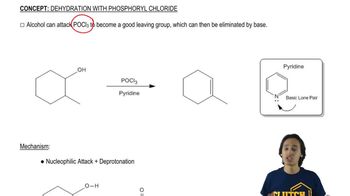
General Reaction of Dehydration with POCl3

Acid-Catalyzed Mechanism

In acid-catalyzed dehydration, the alcohol is protonated by an acid, increasing its electrophilicity. This leads to the formation of a carbocation intermediate, which can then lose a water molecule to form a double bond. The stability of the carbocation and the ability to rearrange can significantly influence the reaction pathway and the final product, such as mesityl oxide in this case.
추천 영상:
06:34
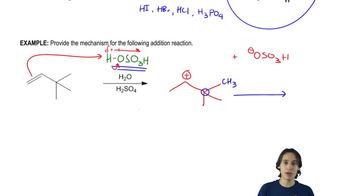
Acid-catalyzed hydration mechanism

Base-Catalyzed Mechanism

In base-catalyzed dehydration, a base abstracts a proton from the alcohol, generating an alkoxide ion that can eliminate a water molecule. This mechanism typically involves a concerted process where the bond formation and bond breaking occur simultaneously, leading to the formation of an alkene. The choice of base and the reaction conditions can affect the efficiency and selectivity of the dehydration process.
추천 영상:
01:57
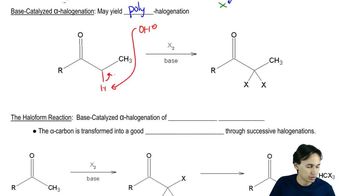
Base Catalyzed