Ch. 22 - Condensations and Alpha Substitutions of Carbonyl Compounds
Wade - Organic Chemistry 9th Edition
Wade9th EditionOrganic ChemistryISBN: 9780135213728당신이 사용하는 게 아니라요?교과서 변경
22장, 문제 37

Propose a mechanism for the self-condensation of methyl 3-phenylpropionate promoted by sodium methoxide.

검증된 단계별 안내
1
Identify the reaction type: The self-condensation of methyl 3-phenylpropionate is a Claisen condensation, which involves the reaction of two ester molecules in the presence of a strong base to form a β-keto ester.
Step 1: Deprotonation of the α-hydrogen. Sodium methoxide (a strong base) abstracts the acidic α-hydrogen from one molecule of methyl 3-phenylpropionate, forming a resonance-stabilized enolate ion. Represent the enolate ion as: CH2(C6H5)COOCH3 → CH(C6H5)=C-OCH3.
Step 2: Nucleophilic attack by the enolate. The enolate ion acts as a nucleophile and attacks the carbonyl carbon of a second molecule of methyl 3-phenylpropionate. This forms a tetrahedral intermediate. Represent the intermediate as: CH(C6H5)=C-OCH3 + CH2(C6H5)COOCH3 → [tetrahedral intermediate].
Step 3: Elimination of methoxide ion. The tetrahedral intermediate collapses, expelling a methoxide ion (CH3O-) and forming the β-keto ester product. Represent the product as: CH(C6H5)COCH(C6H5)COOCH3.
Step 4: Regeneration of the base. The expelled methoxide ion can deprotonate another molecule of methyl 3-phenylpropionate, continuing the catalytic cycle. This ensures that sodium methoxide is regenerated and can promote further reactions.

비슷한 문제에 대한 검증된 영상 답변:

이 영상 해법은 위 문제에 도움이 된다고 튜터들이 추천한 것입니다.

주요 개념

질문에 올바르게 답하기 위해 반드시 이해해야 하는 핵심 개념들은 다음과 같습니다.

Self-Condensation

Self-condensation is a reaction where a molecule reacts with itself to form a larger compound. In the case of methyl 3-phenylpropionate, this process involves the formation of a new carbon-carbon bond between two identical molecules, leading to the creation of a dimer or oligomer. Understanding this concept is crucial for predicting the products and mechanisms involved in the reaction.
추천 영상:
05:53
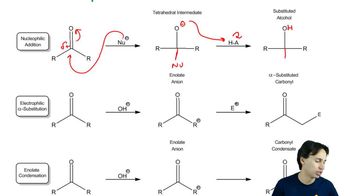
Condensation Reactions

Nucleophilic Attack

Nucleophilic attack is a fundamental reaction mechanism in organic chemistry where a nucleophile, which is an electron-rich species, attacks an electrophile, an electron-deficient species. In this scenario, sodium methoxide acts as a nucleophile, attacking the carbonyl carbon of methyl 3-phenylpropionate, facilitating the formation of a new bond. This step is essential for understanding how the self-condensation occurs.
추천 영상:
08:27
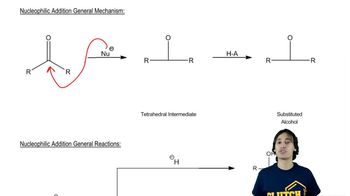
Nucleophilic Addition

Base Catalysis

Base catalysis refers to the acceleration of a chemical reaction by a base, which can deprotonate acidic protons and generate nucleophiles. In this reaction, sodium methoxide not only serves as a nucleophile but also acts as a base, enhancing the reactivity of the carbonyl compound. Recognizing the role of base catalysis is vital for comprehending the overall mechanism of the self-condensation process.
추천 영상:
가이드 코스
2:50
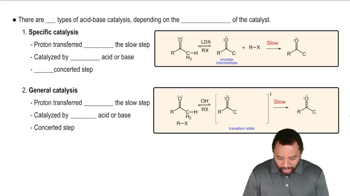
Acid-Base Catalysis Concept 3