Ch. 22 - Condensations and Alpha Substitutions of Carbonyl Compounds
Wade - Organic Chemistry 9th Edition
Wade9th EditionOrganic ChemistryISBN: 9780135213728당신이 사용하는 게 아니라요?교과서 변경
22장, 문제 32c

Show how each compound can be dissected into reagents joined by an aldol condensation, then decide whether the necessary aldol condensation is feasible.
(c)

검증된 단계별 안내
1
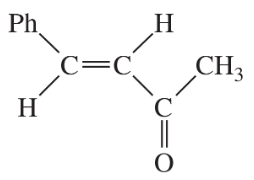
Step 1: Identify the product of the aldol condensation. The given compound contains a β-hydroxy ketone structure that has undergone dehydration to form an α,β-unsaturated ketone. This indicates it is the result of an aldol condensation followed by elimination of water.
Step 2: Break the compound into two potential reagents. In an aldol condensation, one reagent acts as the enolate ion (nucleophile) and the other as the carbonyl compound (electrophile). Here, the compound can be dissected into benzaldehyde (PhCHO) and acetone (CH3COCH3).
Step 3: Analyze the feasibility of forming the enolate. Acetone can form an enolate ion under basic conditions because it has acidic α-hydrogens adjacent to the carbonyl group. This enolate can attack the electrophilic carbonyl carbon of benzaldehyde.
Step 4: Consider the aldol addition step. The enolate ion of acetone will attack the carbonyl carbon of benzaldehyde, forming a β-hydroxy ketone intermediate. This intermediate is stable under basic conditions.
Step 5: Evaluate the dehydration step. Under heating or continued basic conditions, the β-hydroxy ketone intermediate undergoes elimination of water to form the α,β-unsaturated ketone product shown in the image. This dehydration step is feasible and commonly occurs in aldol condensations.

비슷한 문제에 대한 검증된 영상 답변:

이 영상 해법은 위 문제에 도움이 된다고 튜터들이 추천한 것입니다.
영상 길이:
3m

주요 개념

질문에 올바르게 답하기 위해 반드시 이해해야 하는 핵심 개념들은 다음과 같습니다.

Aldol Condensation

Aldol condensation is a reaction between aldehydes or ketones that contain alpha-hydrogens, leading to the formation of β-hydroxy aldehydes or ketones. This reaction involves the nucleophilic addition of an enolate ion to a carbonyl carbon, followed by dehydration to form an α,β-unsaturated carbonyl compound. Understanding this mechanism is crucial for dissecting compounds into their respective reagents.
추천 영상:
09:51
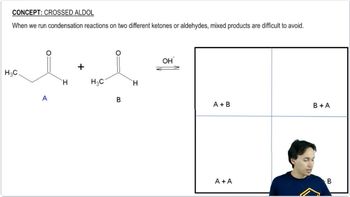
Crossed Aldol

Enolate Ion Formation

Enolate ions are formed when a base abstracts an alpha-hydrogen from a carbonyl compound, resulting in a resonance-stabilized anion. This ion acts as a nucleophile in aldol reactions, allowing it to attack another carbonyl compound. Recognizing how to generate enolate ions from the given compounds is essential for determining the feasibility of the aldol condensation.
추천 영상:
02:26
Formation of Enolates

Feasibility of Aldol Condensation

The feasibility of an aldol condensation depends on the stability of the resulting products and the reaction conditions. Factors such as steric hindrance, electronic effects, and the presence of suitable bases or acids influence whether the reaction will proceed. Evaluating these factors helps in deciding if the aldol condensation can occur with the given compounds.
추천 영상:
09:51
Crossed Aldol