
Ch. 22 - Condensations and Alpha Substitutions of Carbonyl Compounds
Wade - Organic Chemistry 9th Edition
Wade9th EditionOrganic ChemistryISBN: 9780135213728당신이 사용하는 게 아니라요?교과서 변경
22장, 문제 75c

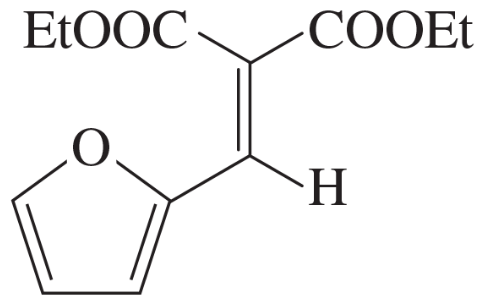
The Knoevenagel condensation is a special case of the aldol condensation in which an active methylene compound reacts with an aldehyde or ketone, in the presence of a secondary amine as a basic catalyst, to produce a new C=C. Show the starting materials that made each of these by a Knoevenagel condensation.
(c)

검증된 단계별 안내
1
Identify the product of the Knoevenagel condensation. The product will contain a new C=C bond formed between the alpha-carbon of the active methylene compound and the carbonyl carbon of the aldehyde or ketone.
Determine the active methylene compound. Active methylene compounds typically have two electron-withdrawing groups (e.g., -CN, -COOR, -NO2) attached to the same carbon, making the hydrogens on that carbon acidic and capable of forming a carbanion.
Determine the aldehyde or ketone used in the reaction. The carbonyl group of the aldehyde or ketone reacts with the carbanion formed from the active methylene compound to form the C=C bond.
Write the reaction mechanism. The reaction typically proceeds via deprotonation of the active methylene compound by the basic catalyst (secondary amine), followed by nucleophilic attack of the carbanion on the carbonyl carbon of the aldehyde or ketone. This is followed by elimination of water to form the final product.
Combine the identified starting materials (active methylene compound and aldehyde/ketone) to show the reactants that would produce the given product via the Knoevenagel condensation.

비슷한 문제에 대한 검증된 영상 답변:

이 영상 해법은 위 문제에 도움이 된다고 튜터들이 추천한 것입니다.

주요 개념

질문에 올바르게 답하기 위해 반드시 이해해야 하는 핵심 개념들은 다음과 같습니다.

Knoevenagel Condensation

The Knoevenagel condensation is a reaction where an active methylene compound reacts with an aldehyde or ketone in the presence of a basic catalyst, typically a secondary amine. This reaction results in the formation of a carbon-carbon double bond (C=C) and is characterized by the elimination of a small molecule, often water. It is a key reaction in organic synthesis for forming α,β-unsaturated carbonyl compounds.
추천 영상:
05:53
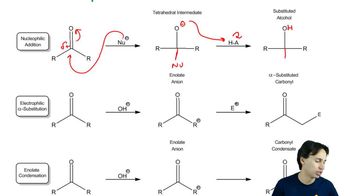
Condensation Reactions

Active Methylene Compounds

Active methylene compounds are organic molecules that contain a methylene group (–CH2–) adjacent to a carbonyl group (C=O) or another electron-withdrawing group. This structure makes the methylene hydrogen atoms particularly acidic, allowing them to be deprotonated and participate in nucleophilic reactions. Examples include malonic ester and acetoacetic ester, which are commonly used in Knoevenagel condensations.
추천 영상:
01:40
Defining meso compounds.

Aldol Condensation

Aldol condensation is a fundamental reaction in organic chemistry where aldehydes or ketones with α-hydrogens undergo a reaction to form β-hydroxy carbonyl compounds, which can further dehydrate to yield α,β-unsaturated carbonyl compounds. The Knoevenagel condensation can be viewed as a specific type of aldol condensation where the reaction involves an active methylene compound, highlighting the versatility of carbonyl chemistry in forming complex molecules.
추천 영상:
09:51
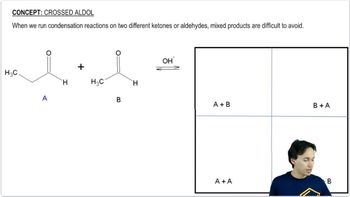
Crossed Aldol
관련 실천
교과서 질문

The following compounds can be synthesized by aldol condensations, followed by further reactions. (In each case, work backward from the target molecule to an aldol product, and show what compounds are needed for the condensation.)

(c)

1068
views
교과서 질문

The Knoevenagel condensation is a special case of the aldol condensation in which an active methylene compound reacts with an aldehyde or ketone, in the presence of a secondary amine as a basic catalyst, to produce a new C=C. Show the starting materials that made each of these by a Knoevenagel condensation.

(a)

2542
views
교과서 질문

The Knoevenagel condensation is a special case of the aldol condensation in which an active methylene compound reacts with an aldehyde or ketone, in the presence of a secondary amine as a basic catalyst, to produce a new C=C. Show the starting materials that made each of these by a Knoevenagel condensation.

(f)

601
views
교과서 질문

The Knoevenagel condensation is a special case of the aldol condensation in which an active methylene compound reacts with an aldehyde or ketone, in the presence of a secondary amine as a basic catalyst, to produce a new C=C. Show the starting materials that made each of these by a Knoevenagel condensation.

(e)

594
views
교과서 질문

The Knoevenagel condensation is a special case of the aldol condensation in which an active methylene compound reacts with an aldehyde or ketone, in the presence of a secondary amine as a basic catalyst, to produce a new C=C. Show the starting materials that made each of these by a Knoevenagel condensation.

(d)

712
views
교과서 질문

The Knoevenagel condensation is a special case of the aldol condensation in which an active methylene compound reacts with an aldehyde or ketone, in the presence of a secondary amine as a basic catalyst, to produce a new C=C. Show the starting materials that made each of these by a Knoevenagel condensation.

(b)

1053
views