Ch. 22 - Condensations and Alpha Substitutions of Carbonyl Compounds
Wade - Organic Chemistry 9th Edition
Wade9th EditionOrganic ChemistryISBN: 9780135213728당신이 사용하는 게 아니라요?교과서 변경
22장, 문제 7

Without looking back, propose a mechanism for the hydrolysis of this iminium salt to the alkylated ketone. The first step is attack by water, followed by loss of a proton to give a carbinolamine. Protonation on nitrogen allows pyrrolidine to leave, giving the protonated ketone.

검증된 단계별 안내
1
Identify the iminium salt structure. The iminium ion typically has a positively charged nitrogen atom double-bonded to a carbon atom. This is the reactive center for the hydrolysis reaction.
Initiate the mechanism with the nucleophilic attack by water (H₂O) on the carbon atom of the iminium ion. This step involves the lone pair of electrons on the oxygen atom of water attacking the electrophilic carbon, forming a bond between the oxygen and carbon.
Following the nucleophilic attack, a proton transfer occurs. The oxygen atom of the water molecule, now bonded to the carbon, will lose a proton (H⁺) to form a carbinolamine intermediate. This step stabilizes the intermediate by neutralizing the charge on the oxygen.
Protonation of the nitrogen atom in the carbinolamine intermediate occurs next. This step involves the nitrogen atom accepting a proton (H⁺), which increases the leaving group ability of the pyrrolidine ring attached to the nitrogen.
Finally, the pyrrolidine group leaves, resulting in the formation of a protonated ketone. The nitrogen atom, now positively charged, facilitates the departure of the pyrrolidine, leaving behind the alkylated ketone structure.

비슷한 문제에 대한 검증된 영상 답변:

이 영상 해법은 위 문제에 도움이 된다고 튜터들이 추천한 것입니다.
영상 길이:
7m

주요 개념

질문에 올바르게 답하기 위해 반드시 이해해야 하는 핵심 개념들은 다음과 같습니다.

Iminium Salt

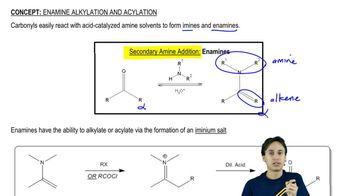
An iminium salt is a positively charged intermediate formed when an amine reacts with a carbonyl compound. It features a nitrogen atom double-bonded to a carbon atom, which is also bonded to a leaving group. Understanding iminium salts is crucial for grasping the hydrolysis mechanism, as they are key intermediates in the transformation to ketones.
추천 영상:
03:36
General Reaction

Nucleophilic Attack

Nucleophilic attack is a fundamental reaction mechanism in organic chemistry where a nucleophile, such as water in this case, donates an electron pair to an electrophile, leading to bond formation. In the hydrolysis of iminium salts, water acts as the nucleophile, attacking the electrophilic carbon of the iminium, which initiates the conversion to a carbinolamine.
추천 영상:
08:27
Nucleophilic Addition

Proton Transfer

Proton transfer is a common process in organic reactions where a proton (H+) is transferred from one atom to another, often facilitating the conversion of intermediates. In the hydrolysis mechanism described, the loss of a proton from the carbinolamine leads to the formation of a more stable structure, ultimately resulting in the generation of the protonated ketone after the leaving group departs.
추천 영상:
03:
Proton Splitting