
Like glucose, galactose mutarotates when it dissolves in water. The specific rotation of α-D-galactopyranose is +150.7°, and that of the β anomer is +52.8°. When either of the pure anomers dissolves in water, the specific rotation gradually changes to +80.2°. Determine the percentages of the two anomers present at equilibrium.
Ch. 23 - Carbohydrates and Nucleic Acids
23장, 문제 10a
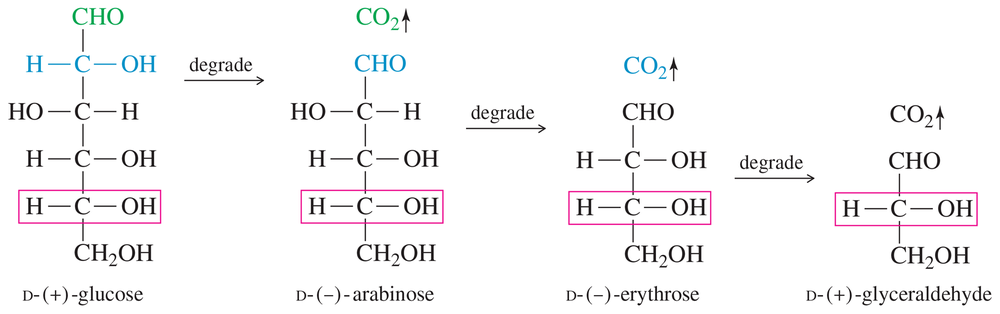
Figure 23-2 shows that the degradation of D-glucose gives D-arabinose, an aldopentose. Arabinose is most stable in its furanose form. Draw D-arabinofuranose.

검증된 단계별 안내1
Understand the problem: The degradation of D-glucose to D-arabinose involves the loss of one carbon atom, resulting in an aldopentose (a five-carbon sugar with an aldehyde group). The problem asks us to draw D-arabinofuranose, the furanose form of D-arabinose.
Recall the furanose form: A furanose is a five-membered ring structure formed when the hydroxyl group on the penultimate carbon (C-4 in this case) reacts with the aldehyde group on C-1, creating a cyclic hemiacetal.
Determine the stereochemistry: D-arabinose is a D-sugar, meaning the hydroxyl group on the penultimate carbon (C-4) is on the right in the Fischer projection. This stereochemistry must be preserved in the furanose form.
Draw the ring structure: Start by drawing a five-membered ring (furanose). Place the oxygen atom as one of the ring members. Attach the aldehyde-derived carbon (C-1) and the penultimate carbon (C-4) to the ring, ensuring the correct stereochemistry for the hydroxyl groups on C-2, C-3, and C-4.
Add substituents: Place the hydroxyl groups and hydrogen atoms on the appropriate carbons in the ring, ensuring the stereochemistry matches that of D-arabinose. The hydroxyl group on C-1 will be part of the hemiacetal linkage, and the remaining hydroxyl groups should be positioned according to the D-arabinose configuration.

비슷한 문제에 대한 검증된 영상 답변:
이 영상 해법은 위 문제에 도움이 된다고 튜터들이 추천한 것입니다.
영상 길이:
4m주요 개념
질문에 올바르게 답하기 위해 반드시 이해해야 하는 핵심 개념들은 다음과 같습니다.
Aldopentose Structure
Aldopentoses are monosaccharides that contain five carbon atoms and an aldehyde functional group. D-arabinose, specifically, is an aldopentose with a specific configuration at each chiral center. Understanding the structure of aldopentoses is crucial for recognizing their properties and reactivity in biochemical processes.
추천 영상:
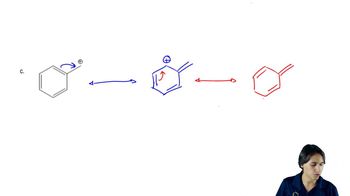
Drawing Resonance Structures
Furanose Form
The furanose form refers to a cyclic structure of sugars that resembles a five-membered ring, typically formed when a hydroxyl group reacts with the carbonyl group. In the case of D-arabinose, the furanose form is the most stable configuration, which influences its chemical behavior and interactions in biological systems.
추천 영상:
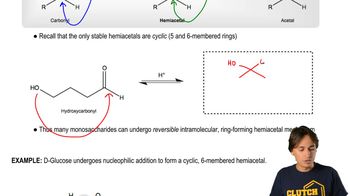
Monosaccharides - Forming Cyclic Hemiacetals
Cyclization of Sugars
Cyclization is the process by which linear forms of sugars convert into cyclic structures, significantly affecting their stability and reactivity. This transformation involves the nucleophilic attack of a hydroxyl group on the carbonyl carbon, leading to the formation of either pyranose (six-membered) or furanose (five-membered) rings, which are essential for understanding carbohydrate chemistry.
추천 영상:
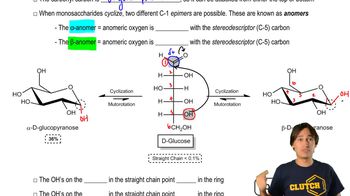
Monosaccharides - Cyclization
관련 실천
교과서 질문
1825
views
1
rank
교과서 질문
The carbonyl group in D-galactose may be isomerized from C1 to C2 by brief treatment with dilute base (by the enediol rearrangement). The product is the C4 epimer of fructose. Draw the furanose structure of the product.
699
views
교과서 질문
Talose is the C4 epimer of mannose. Draw the chair conformation of D-talopyranose.
1643
views
교과서 질문
Allose is the C3 epimer of glucose. Draw the cyclic hemiacetal form of D-allose, first in the chair conformation and then in the Haworth projection.
1669
views
교과서 질문
Draw the Haworth projection for the cyclic structure of D-mannose by laying down the Fischer projection.
2318
views
교과서 질문
Ribose, the C2 epimer of arabinose, is most stable in its furanose form. Draw D-ribofuranose.
1482
views
