Ch. 23 - Carbohydrates and Nucleic Acids
Wade - Organic Chemistry 9th Edition
Wade9th EditionOrganic ChemistryISBN: 9780135213728당신이 사용하는 게 아니라요?교과서 변경
23장, 문제 2c

How many asymmetric carbons and stereoisomers are there for an aldohexose? For a ketohexose?

검증된 단계별 안내
1
Identify the structure of an aldohexose: Aldohexoses are six-carbon sugars with an aldehyde group at the first carbon. The remaining carbons (C2 to C6) are connected by single bonds, with hydroxyl (-OH) groups attached to some of them.
Determine the number of asymmetric carbons in an aldohexose: Asymmetric carbons (chiral centers) are carbons bonded to four different groups. In an aldohexose, the aldehyde group at C1 is not chiral, but the carbons at C2, C3, C4, and C5 are chiral. Therefore, there are 4 asymmetric carbons in an aldohexose.
Calculate the number of stereoisomers for an aldohexose: The number of stereoisomers is given by the formula \( 2^n \), where \( n \) is the number of asymmetric carbons. For an aldohexose with 4 chiral centers, the number of stereoisomers is \( 2^4 \).
Identify the structure of a ketohexose: Ketohexoses are six-carbon sugars with a ketone group at the second carbon. The remaining carbons (C1, C3 to C6) are connected by single bonds, with hydroxyl (-OH) groups attached to some of them.
Determine the number of asymmetric carbons and stereoisomers for a ketohexose: In a ketohexose, the ketone group at C2 is not chiral. The carbons at C3, C4, and C5 are chiral, while C1 and C6 are not. Therefore, there are 3 asymmetric carbons, and the number of stereoisomers is \( 2^3 \).

비슷한 문제에 대한 검증된 영상 답변:

이 영상 해법은 위 문제에 도움이 된다고 튜터들이 추천한 것입니다.
영상 길이:
3m

주요 개념

질문에 올바르게 답하기 위해 반드시 이해해야 하는 핵심 개념들은 다음과 같습니다.

Asymmetric Carbons

Asymmetric carbons, or chiral centers, are carbon atoms that are bonded to four different substituents. The presence of asymmetric carbons in a molecule leads to the possibility of stereoisomerism, where molecules can exist in different spatial arrangements. In aldohexoses and ketohexoses, the number of asymmetric carbons directly influences the number of stereoisomers that can be formed.
추천 영상:
03:38
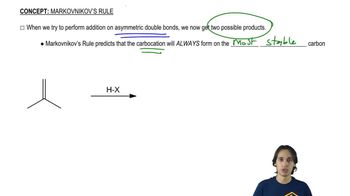
How to add to asymmetrical double bonds.

Stereoisomers

Stereoisomers are compounds that have the same molecular formula and connectivity of atoms but differ in the spatial arrangement of their atoms. The number of stereoisomers for a compound can be calculated using the formula 2^n, where n is the number of asymmetric carbons. This concept is crucial for understanding the diversity of structures that can arise from simple sugars like aldohexoses and ketohexoses.
추천 영상:
01:58
Determining when molecules are stereoisomers.

Aldohexose vs. Ketohexose

Aldohexoses are six-carbon sugars with an aldehyde group at one end, while ketohexoses have a ketone group typically at the second carbon. The structural differences between these two types of hexoses affect the number of asymmetric carbons they possess, which in turn influences the total number of stereoisomers. Understanding these distinctions is essential for determining the stereochemical complexity of these carbohydrates.
추천 영상:
03:06
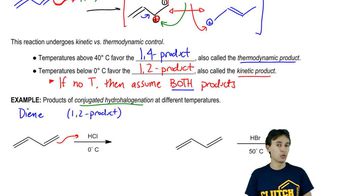
1,2 vs. 1,4 products