Ch. 23 - Carbohydrates and Nucleic Acids
Wade - Organic Chemistry 9th Edition
Wade9th EditionOrganic ChemistryISBN: 9780135213728당신이 사용하는 게 아니라요?교과서 변경
23장, 문제 40

Trehalose is a nonreducing disaccharide (C12H22O11) isolated from the poisonous mushroom Amanita muscaria. Treatment with an α-glucosidase converts trehalose to two molecules of glucose, but no reaction occurs when trehalose is treated with a β-glucosidase. When trehalose is methylated by dimethyl sulfate in mild base and then hydrolyzed, the only product is 2,3,4,6-tetra-O-methylglucose. Propose a complete structure and systematic name for trehalose.

검증된 단계별 안내
1
Step 1: Analyze the information provided about trehalose. Trehalose is a nonreducing disaccharide, meaning it does not have a free anomeric carbon capable of reducing other compounds. This suggests that both anomeric carbons in the two glucose units are involved in the glycosidic bond.
Step 2: Consider the enzymatic reaction with α-glucosidase and β-glucosidase. Trehalose is hydrolyzed by α-glucosidase but not by β-glucosidase. This indicates that the glycosidic bond in trehalose is an α-linkage, specifically an α,α-linkage between the two glucose units.
Step 3: Examine the methylation and hydrolysis results. When trehalose is methylated with dimethyl sulfate in a mild base, all hydroxyl groups except those involved in the glycosidic bond are methylated. Hydrolysis of the methylated product yields 2,3,4,6-tetra-O-methylglucose, indicating that the glycosidic bond involves the hydroxyl group at the 1-position of one glucose and the 1-position of the other glucose.
Step 4: Propose the structure of trehalose. Based on the above information, trehalose consists of two glucose units linked by an α,α-1,1-glycosidic bond. This structure satisfies the nonreducing nature of the disaccharide and the enzymatic specificity of α-glucosidase.
Step 5: Provide the systematic name for trehalose. The systematic name is α-D-glucopyranosyl-(1→1)-α-D-glucopyranoside, reflecting the α,α-1,1-glycosidic linkage between the two glucose units.

비슷한 문제에 대한 검증된 영상 답변:

이 영상 해법은 위 문제에 도움이 된다고 튜터들이 추천한 것입니다.
영상 길이:
7m

주요 개념

질문에 올바르게 답하기 위해 반드시 이해해야 하는 핵심 개념들은 다음과 같습니다.

Disaccharides

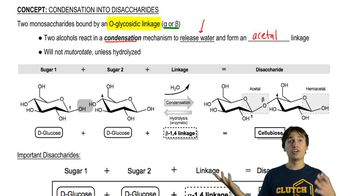
Disaccharides are carbohydrates formed by the condensation of two monosaccharide units, linked by a glycosidic bond. In the case of trehalose, it consists of two glucose molecules connected by an α(1→1) bond, making it a nonreducing sugar. Understanding the structure and properties of disaccharides is essential for analyzing their reactivity and behavior in biochemical processes.
추천 영상:
07:31
Disaccharide

Glycosidic Bonds

Glycosidic bonds are covalent linkages that connect monosaccharides in carbohydrates. The type of glycosidic bond (α or β) determines the reactivity and properties of the sugar. In trehalose, the presence of an α-glycosidic bond explains why it can be hydrolyzed by α-glucosidase but not by β-glucosidase, highlighting the importance of bond type in enzymatic reactions.
추천 영상:
06:00
Single bonds, double bonds, and triple bonds.

Methylation and Hydrolysis

Methylation is a chemical reaction that introduces methyl groups into a molecule, often used to protect hydroxyl groups in sugars. In the case of trehalose, methylation followed by hydrolysis yields 2,3,4,6-tetra-O-methylglucose, indicating that all hydroxyl groups were successfully methylated. This process is crucial for determining the structure of sugars and understanding their functional groups.
추천 영상:
가이드 코스
1:00
Hydrolysis of Thioesters Concept 2
관련 실천