
Ch. 23 - Carbohydrates and Nucleic Acids
Wade - Organic Chemistry 9th Edition
Wade9th EditionOrganic ChemistryISBN: 9780135213728당신이 사용하는 게 아니라요?교과서 변경
23장, 문제 56a

Which of the following sugars are reducing sugars? Which ones would undergo mutarotation?
(a) 4-O-(α-D-glucopyranosyl)-D-galactopyranose

검증된 단계별 안내
1
Step 1: Understand the concept of reducing sugars. Reducing sugars are carbohydrates that can act as reducing agents due to the presence of a free aldehyde group or a free ketone group in their open-chain form. This is typically possible if the anomeric carbon of the sugar is not involved in a glycosidic bond.
Step 2: Analyze the structure of the given sugar, 4-O-(α-D-glucopyranosyl)-D-galactopyranose. This is a disaccharide where the D-galactopyranose unit is linked to the D-glucopyranosyl unit through a glycosidic bond at the 4th carbon of galactopyranose.
Step 3: Determine if the anomeric carbon of each sugar unit is free. In this case, the anomeric carbon of the D-glucopyranosyl unit is involved in the glycosidic bond, so it is not free. However, the anomeric carbon of the D-galactopyranose unit is free, making the disaccharide a reducing sugar.
Step 4: Understand the concept of mutarotation. Mutarotation is the change in the optical rotation of a sugar solution due to the interconversion between its α and β anomers in equilibrium. This process requires a free anomeric carbon that can open to form the linear structure.
Step 5: Conclude that since the D-galactopyranose unit has a free anomeric carbon, the disaccharide can undergo mutarotation. The D-glucopyranosyl unit, however, cannot undergo mutarotation because its anomeric carbon is locked in the glycosidic bond.

비슷한 문제에 대한 검증된 영상 답변:

이 영상 해법은 위 문제에 도움이 된다고 튜터들이 추천한 것입니다.
영상 길이:
9m

주요 개념

질문에 올바르게 답하기 위해 반드시 이해해야 하는 핵심 개념들은 다음과 같습니다.

Reducing Sugars

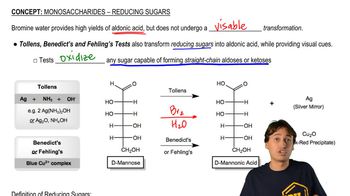
Reducing sugars are carbohydrates that can donate electrons to other molecules, typically due to the presence of a free aldehyde or ketone group. This property allows them to reduce certain chemical reagents, such as Benedict's or Fehling's solution. Common examples include glucose and fructose, which can participate in redox reactions.
추천 영상:
08:42
Reducing Sugars

Mutarotation

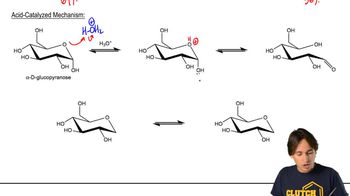
Mutarotation is the change in optical rotation that occurs when an anomeric carbon in a sugar ring opens and closes, interconverting between its alpha and beta forms. This process is significant for sugars with hemiacetal or hemiketal groups, as it affects their reactivity and properties. For example, glucose can exist in both alpha and beta forms, leading to different physical properties.
추천 영상:
03:06
Mechanism

Glycosidic Bonds

Glycosidic bonds are covalent linkages formed between the anomeric carbon of a sugar and another molecule, which can be another sugar or a different type of compound. In the context of disaccharides or oligosaccharides, the presence of a glycosidic bond can prevent mutarotation and the reducing ability of the sugar, as it locks the sugar in a specific configuration.
추천 영상:
06:00
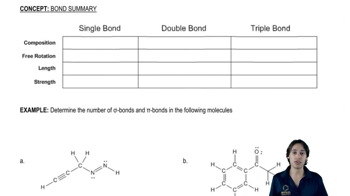
Single bonds, double bonds, and triple bonds.
관련 실천
교과서 질문

Which of the following sugars are reducing sugars? Which ones would undergo mutarotation?

(a) methyl β-D-glucopyranoside

(b) 2,3,4,6-tetra-O-methyl-D-mannopyranose

(c) 1,3,6-tri-O-methyl-D-fructofuranose

(d) methyl 2,3,4,6-tetra-O-methyl-β-D-galactopyranoside

1114
views
교과서 질문

Which of the following sugars are reducing sugars? Which ones would undergo mutarotation?

(c) 6-O-(β-D-galactopyranosyl)-D-glucopyranose

551
views
교과서 질문

Draw the structures (using chair conformations of pyranoses) of the following disaccharides.

(a) 4-O-(α-D-glucopyranosyl)-D-galactopyranose

(b) α-D-fructofuranosyl-β-D-mannopyranoside

(c) 6-O-(β-D-galactopyranosyl)-D-glucopyranose

1435
views
교과서 질문

Which of the following sugars are reducing sugars? Which ones would undergo mutarotation?

(b) α-D-fructofuranosyl-β-D-mannopyranoside

517
views
교과서 질문

Erwin Chargaff’s discovery that DNA contains equimolar amounts of guanine and cytosine and also equimolar amounts of adenine and thymine has come to be known as Chargaff’s rule:

G = C and A = T

(a) Does Chargaff’s rule imply that equal amounts of guanine and adenine are present in DNA? That is, does G = A?

(b) Does Chargaff’s rule imply that the sum of the purine residues equals the sum of the pyrimidine residues? That is, does A + G = C + T?

(c) Does Chargaff’s rule apply only to double-stranded DNA, or would it also apply to each individual strand if the double helical strand were separated into its two complementary strands?

1127
views
교과서 질문

An unknown reducing disaccharide is found to be unaffected by invertase enzymes. Treatment with an α-galactosidase cleaves the disaccharide to give one molecule of D-fructose and one molecule of D-galactose. When the disaccharide is treated with excess iodomethane and silver oxide and then hydrolyzed in dilute acid, the products are 2,3,4,6-tetra-O-methylgalactose and 1,3,4-tri-O-methylfructose. Propose a structure for this disaccharide, and give its complete systematic name.

604
views