Ch. 24 - Amino Acids, Peptides, and Proteins
Wade - Organic Chemistry 9th Edition
Wade9th EditionOrganic ChemistryISBN: 9780135213728당신이 사용하는 게 아니라요?교과서 변경
24장, 문제 15

Give equations for the formation and hydrogenolysis of glutamine benzyl ester.

검증된 단계별 안내
1
Write the structure of glutamine, which is an amino acid with the formula C5H10N2O3. Identify the functional groups: an amine (-NH2), a carboxylic acid (-COOH), and a side chain containing an amide (-CONH2).
To form the benzyl ester of glutamine, react the carboxylic acid group (-COOH) of glutamine with benzyl alcohol (C6H5CH2OH) in the presence of an acid catalyst (e.g., H2SO4) or a coupling agent like DCC (dicyclohexylcarbodiimide). This reaction forms the benzyl ester (-COOCH2C6H5) at the carboxylic acid group.
Write the chemical equation for the esterification reaction: Glutamine + Benzyl alcohol → Glutamine benzyl ester + Water. Use MathML to represent the structures of the reactants and products.
For the hydrogenolysis of glutamine benzyl ester, use a hydrogenation catalyst such as palladium on carbon (Pd/C) under a hydrogen atmosphere (H2). This reaction cleaves the benzyl ester group (-COOCH2C6H5) back to the carboxylic acid (-COOH) and forms toluene (C6H5CH3) as a byproduct.
Write the chemical equation for the hydrogenolysis reaction: Glutamine benzyl ester + H2 → Glutamine + Toluene. Use MathML to represent the structures of the reactants and products.

비슷한 문제에 대한 검증된 영상 답변:

이 영상 해법은 위 문제에 도움이 된다고 튜터들이 추천한 것입니다.
영상 길이:
9m

주요 개념

질문에 올바르게 답하기 위해 반드시 이해해야 하는 핵심 개념들은 다음과 같습니다.

Formation of Glutamine Benzyl Ester

The formation of glutamine benzyl ester involves the reaction of glutamine, an amino acid, with benzyl alcohol in the presence of an acid catalyst. This process is known as esterification, where the carboxylic acid group of glutamine reacts with the hydroxyl group of benzyl alcohol, resulting in the formation of an ester bond and the release of water.
추천 영상:
가이드 코스
1:01
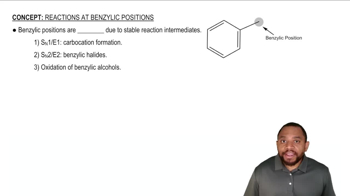
Reactions at Benzylic Positions Concept 1

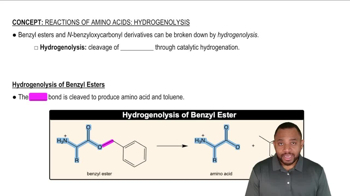
Hydrogenolysis

Hydrogenolysis is a chemical reaction that involves the cleavage of a bond in the presence of hydrogen, typically using a catalyst such as palladium or platinum. In the context of glutamine benzyl ester, hydrogenolysis would break the ester bond, converting the ester back into glutamine and benzyl alcohol. This reaction is important for the selective removal of protecting groups in organic synthesis.
추천 영상:
가이드 코스
2:01
Reactions of Amino Acids: Hydrogenolysis Concept 1

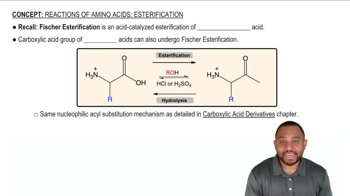
Esterification and Hydrolysis Reactions

Esterification and hydrolysis are fundamental organic reactions involving the formation and breakdown of esters. Esterification is the process of forming an ester from an alcohol and a carboxylic acid, while hydrolysis is the reverse reaction, where an ester reacts with water to yield an alcohol and a carboxylic acid. Understanding these reactions is crucial for manipulating and synthesizing organic compounds in the laboratory.
추천 영상:
가이드 코스
1:21
Reactions of Amino Acids: Esterification Concept 1