Ch. 24 - Amino Acids, Peptides, and Proteins
Wade - Organic Chemistry 9th Edition
Wade9th EditionOrganic ChemistryISBN: 9780135213728당신이 사용하는 게 아니라요?교과서 변경
24장, 문제 41

Histidine is an important catalytic residue found at the active sites of many enzymes. In many cases, histidine appears to remove protons or to transfer protons from one location to another.
(a) Show which nitrogen atom of the histidine heterocycle is basic and which is not.
(b) Use resonance forms to show why the protonated form of histidine is a particularly stable cation.
(c) Show the structure that results when histidine accepts a proton on the basic nitrogen of the heterocycle and then is deprotonated on the other heterocyclic nitrogen. Explain how histidine might function as a pipeline to transfer protons between sites within an enzyme and its substrate.

검증된 단계별 안내
1
Step 1: Analyze the structure of histidine's heterocyclic ring (imidazole). The imidazole ring contains two nitrogen atoms: one is part of a double bond (sp2 hybridized) and the other is bonded to a hydrogen atom (sp2 hybridized but capable of donating a lone pair). The nitrogen bonded to hydrogen is basic because it can donate its lone pair to accept a proton.
Step 2: To determine why the protonated form of histidine is stable, draw resonance structures for the protonated imidazole ring. Show how the positive charge can delocalize across the ring, stabilizing the cation through resonance.
Step 3: When histidine accepts a proton on the basic nitrogen, draw the resulting structure. Then, show the deprotonation of the other nitrogen atom in the heterocycle. This results in a neutral imidazole ring with a proton transferred from one nitrogen to the other.
Step 4: Explain how histidine functions as a proton pipeline. The ability of histidine to accept and donate protons through its imidazole ring allows it to transfer protons between the enzyme active site and the substrate. This is facilitated by the resonance stabilization of the intermediate forms.
Step 5: Relate the structure of urocanic acid (shown in the image) to histidine. Urocanic acid is a derivative of histidine where the amino group is replaced by a double bond to a carbon chain. This structure highlights the importance of the imidazole ring in proton transfer and catalytic activity.

비슷한 문제에 대한 검증된 영상 답변:

이 영상 해법은 위 문제에 도움이 된다고 튜터들이 추천한 것입니다.
영상 길이:
8m

주요 개념

질문에 올바르게 답하기 위해 반드시 이해해야 하는 핵심 개념들은 다음과 같습니다.

Basicity of Nitrogen Atoms

In histidine, the basicity of nitrogen atoms is determined by their ability to accept protons. The nitrogen in the imidazole ring can be protonated, making it a basic site, while the other nitrogen is part of a double bond and is less likely to accept a proton due to resonance stabilization. Understanding which nitrogen is basic is crucial for analyzing histidine's role in enzymatic reactions.
추천 영상:
가이드 코스
1:45
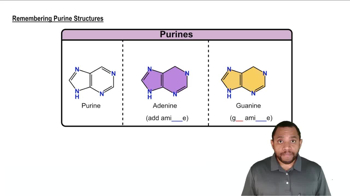
Nitrogenous Bases Concept 3

Resonance Stabilization

Resonance stabilization occurs when a molecule can be represented by multiple valid Lewis structures, distributing electron density across the molecule. In the case of protonated histidine, resonance forms show that the positive charge can be delocalized over the nitrogen atoms and the adjacent carbon atoms, enhancing the stability of the cation. This concept is essential for understanding the stability of charged species in biochemical reactions.
추천 영상:
03:43
The radical stability trend.

Proton Transfer Mechanism

Histidine can act as a proton shuttle in enzymatic reactions, facilitating the transfer of protons between different sites. When histidine accepts a proton on its basic nitrogen, it can later donate it from the other nitrogen, effectively transferring protons within the enzyme's active site. This mechanism is vital for many enzymatic processes, as it allows for the regulation of pH and the stabilization of transition states.
추천 영상:
가이드 코스
3:05
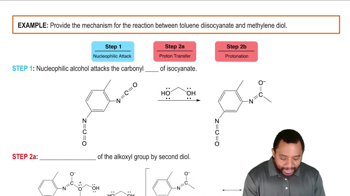
Polyurethane Mechanism Example 1
관련 실천
교과서 질문

There are many methods for activating a carboxylic acid in preparation for coupling with an amine. The following method converts the acid to an N-hydroxysuccinimide (NHS) ester.

(b) Propose a mechanism for the reaction shown.

462
views

교과서 질문

Lipoic acid is often found near the active sites of enzymes, usually bound to the peptide by a long, flexible amide linkage with a lysine residue.


(a) Is lipoic acid a mild oxidizing agent or a mild reducing agent? Draw it in both its oxidized and reduced forms.

(b) Show how lipoic acid might react with two Cys residues to form a disulfide bridge.

(c) Give a balanced equation for the hypothetical oxidation or reduction, as you predicted in part (a), of an aldehyde by lipoic acid.

1358
views
교과서 질문

Metabolism of arginine produces urea and the rare amino acid ornithine. Ornithine has an isoelectric point close to 10. Propose a structure for ornithine.

1499
views
교과서 질문

Aspartame (Nutrasweet®) is a remarkably sweet-tasting dipeptide ester. Complete hydrolysis of aspartame gives phenyl alanine, aspartic acid, and methanol. Mild incubation with carboxypeptidase has no effect on aspartame. Treatment of aspartame with phenyl isothiocyanate, followed by mild hydrolysis, gives the phenylthiohydantoin of aspartic acid. Propose a structure for aspartame.

1420
views
교과서 질문

There are many methods for activating a carboxylic acid in preparation for coupling with an amine. The following method converts the acid to an N-hydroxysuccinimide (NHS) ester.

(a) Explain why an NHS ester is much more reactive than a simple alkyl ester.

649
views
교과서 질문

Show how you would use the Strecker synthesis to make tryptophan. What stereochemistry would you expect in your synthetic product?

1379
views