Ch.4 - The Study of Chemical Reactions
Wade - Organic Chemistry 9th Edition
Wade9th EditionOrganic ChemistryISBN: 9780135213728당신이 사용하는 게 아니라요?교과서 변경
4장, 문제 2a

Write the propagation steps leading to the formation of dichloromethane (CH2Cl2) from chloromethane.

검증된 단계별 안내
1
Step 1: Understand the context of the problem. This is a free radical halogenation reaction involving chloromethane (CH3Cl) and chlorine (Cl2). The propagation steps are part of the chain reaction mechanism where radicals are involved.
Step 2: Write the first propagation step. A chlorine radical (Cl•) reacts with chloromethane (CH3Cl), abstracting a hydrogen atom to form a methyl radical (•CH2Cl) and HCl. The reaction can be represented as: Cl• + CH3Cl → •CH2Cl + HCl.
Step 3: Write the second propagation step. The methyl radical (•CH2Cl) reacts with a chlorine molecule (Cl2), forming dichloromethane (CH2Cl2) and regenerating a chlorine radical (Cl•). The reaction can be represented as: •CH2Cl + Cl2 → CH2Cl2 + Cl•.
Step 4: Recognize that these propagation steps are part of a chain reaction. The chlorine radical generated in the second step can go on to react with another molecule of chloromethane, continuing the cycle.
Step 5: Ensure the overall reaction mechanism is balanced and consistent with the principles of radical halogenation. The propagation steps demonstrate how dichloromethane is formed through successive reactions involving radicals.

비슷한 문제에 대한 검증된 영상 답변:

이 영상 해법은 위 문제에 도움이 된다고 튜터들이 추천한 것입니다.
영상 길이:
1m

주요 개념

질문에 올바르게 답하기 위해 반드시 이해해야 하는 핵심 개념들은 다음과 같습니다.

Free Radical Halogenation

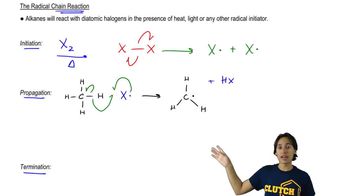
Free radical halogenation is a reaction mechanism where alkanes react with halogens (like Cl2) in the presence of heat or light to form alkyl halides. This process involves the generation of free radicals, which are highly reactive species with unpaired electrons. The reaction proceeds through three main steps: initiation, propagation, and termination, with the propagation steps being crucial for the formation of products like dichloromethane.
추천 영상:
12:11
Radical Chain Reaction Mechanism.

Propagation Steps

Propagation steps in a free radical reaction are the stages where the free radicals react with the substrate to form new radicals and products. In the case of chloromethane to dichloromethane, the chlorine radical abstracts a hydrogen atom from chloromethane, forming dichloromethane and generating a new methyl radical, which can further react with another chlorine molecule. This cycle continues until termination occurs.
추천 영상:
가이드 코스
1:05
Step-Growth Polymers Concept 1

Selectivity in Halogenation

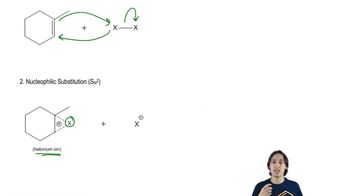
Selectivity in halogenation refers to the preference of a halogen to react with certain hydrogen atoms over others in a molecule. In the case of chloromethane, the chlorine radical can abstract hydrogen from the methyl group, leading to the formation of dichloromethane. The selectivity is influenced by factors such as the stability of the resulting radicals and the bond dissociation energies of the C-H bonds.
추천 영상:
03:45
Halogenation Mechanism