

Ch.4 - The Study of Chemical Reactions
Wade - Organic Chemistry 9th Edition
Wade9th EditionOrganic ChemistryISBN: 9780135213728당신이 사용하는 게 아니라요?교과서 변경
4장, 문제 45a

Draw the important resonance forms of the following free radicals.
a.

검증된 단계별 안내
1
Identify the structure of the given free radical: CH2=CH—⋅CH2. The radical is located on the terminal carbon of the allyl group.
Recognize that resonance involves the delocalization of electrons. In this case, the unpaired electron on the terminal carbon can interact with the π-electrons of the double bond.
Draw the first resonance structure by moving the π-electrons of the C=C double bond towards the carbon with the unpaired electron, forming a new π-bond between the central carbon and the terminal carbon.
As a result of the electron movement, the central carbon now has an unpaired electron. Draw the second resonance structure showing this new distribution of electrons.
Ensure that all resonance structures maintain the same number of unpaired electrons and that the overall charge of the molecule remains unchanged. The resonance structures should be depicted with a double-headed arrow between them to indicate resonance.

비슷한 문제에 대한 검증된 영상 답변:

이 영상 해법은 위 문제에 도움이 된다고 튜터들이 추천한 것입니다.
영상 길이:
3m

주요 개념

질문에 올바르게 답하기 위해 반드시 이해해야 하는 핵심 개념들은 다음과 같습니다.

Resonance

Resonance in organic chemistry refers to the delocalization of electrons within a molecule, which can be represented by multiple structures called resonance forms. These forms illustrate different possible distributions of electrons, particularly in pi bonds or lone pairs, that contribute to the overall hybrid structure of the molecule. Understanding resonance is crucial for predicting the stability and reactivity of molecules.
추천 영상:
03:04
Drawing Resonance Structures

Free Radicals

Free radicals are atoms or molecules that contain an unpaired electron, making them highly reactive. In organic chemistry, free radicals can participate in various reactions, such as addition or substitution, due to their tendency to pair their unpaired electron. Recognizing the presence of a free radical is essential for understanding its potential resonance forms and reactivity.
추천 영상:
03:28
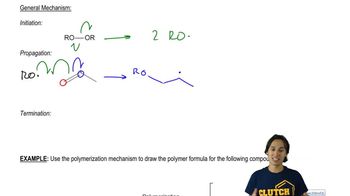
The mechanism of Radical Polymerization.

Allylic Position

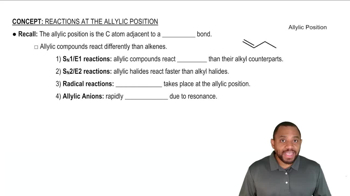
The allylic position refers to the carbon atom adjacent to a carbon-carbon double bond. In the context of resonance, an allylic radical can stabilize through resonance by delocalizing the unpaired electron over the pi system of the double bond. This delocalization often results in multiple resonance forms, which are important for understanding the stability and reactivity of allylic radicals.
추천 영상:
가이드 코스
1:26
Reactions at the Allylic Position Concept 1