Ch.4 - The Study of Chemical Reactions
Wade - Organic Chemistry 9th Edition
Wade9th EditionOrganic ChemistryISBN: 9780135213728당신이 사용하는 게 아니라요?교과서 변경
4장, 문제 4a,b

Free-radical chlorination of hexane gives very poor yields of 1-chlorohexane, while cyclohexane can be converted to chlorocyclohexane in good yield.
a. How do you account for this difference?
b. What ratio of reactants (cyclohexane and chlorine) would you use for the synthesis of chlorocyclohexane?

검증된 단계별 안내
1
Step 1: Understand the mechanism of free-radical chlorination. Free-radical chlorination involves three steps: initiation, propagation, and termination. The reaction proceeds via the formation of free radicals, and the selectivity of the reaction depends on the stability of the intermediate radicals formed.
Step 2: Analyze part (a). In hexane, free-radical chlorination can occur at multiple positions, leading to a mixture of products. The hydrogen atoms on the primary carbons are less reactive compared to secondary or tertiary carbons, so 1-chlorohexane is formed in poor yield. In contrast, cyclohexane has only one type of hydrogen (all are equivalent), so the reaction leads to a single product, chlorocyclohexane, in good yield.
Step 3: Explain the difference in product distribution. The poor yield of 1-chlorohexane in hexane is due to the lack of selectivity and the competition between primary and secondary hydrogens. Cyclohexane avoids this issue because all hydrogens are equivalent, simplifying the reaction and improving the yield of chlorocyclohexane.
Step 4: Address part (b). To synthesize chlorocyclohexane, it is important to use a controlled ratio of cyclohexane to chlorine. Typically, an excess of cyclohexane is used to minimize the formation of poly-chlorinated products. This ensures that each chlorine molecule reacts with only one cyclohexane molecule, favoring the formation of the mono-chlorinated product.
Step 5: Summarize the approach. For part (a), the difference in yields is due to the selectivity of the reaction and the equivalence of hydrogens in cyclohexane. For part (b), using an excess of cyclohexane relative to chlorine helps achieve a good yield of chlorocyclohexane by limiting over-chlorination.

비슷한 문제에 대한 검증된 영상 답변:

이 영상 해법은 위 문제에 도움이 된다고 튜터들이 추천한 것입니다.
영상 길이:
10m

주요 개념

질문에 올바르게 답하기 위해 반드시 이해해야 하는 핵심 개념들은 다음과 같습니다.

Free Radical Mechanism

Free radical chlorination involves the formation of free radicals through the homolytic cleavage of the Cl-Cl bond, leading to a chain reaction. In this process, the stability of the resulting radicals significantly influences the reaction's efficiency. Hexane, with its primary and secondary hydrogens, produces less stable radicals compared to cyclohexane, which has more symmetrical and stable secondary radicals, resulting in lower yields for 1-chlorohexane.
추천 영상:
03:28
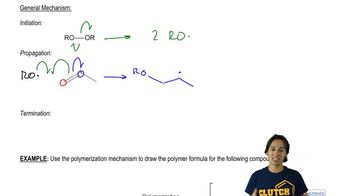
The mechanism of Radical Polymerization.

Selectivity in Chlorination

The selectivity of chlorination reactions is influenced by the stability of the radicals formed during the reaction. Cyclohexane, due to its ring structure, allows for the formation of more stable secondary radicals, leading to a higher yield of chlorocyclohexane. In contrast, hexane's primary radicals are less stable, making the formation of 1-chlorohexane less favorable and resulting in poor yields.
추천 영상:
03:03
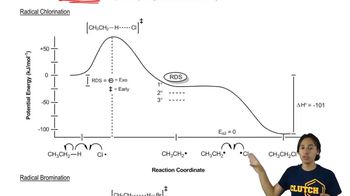
Using the Hammond Postulate to describe radical chlorination.

Stoichiometry of Reactants

The stoichiometry of reactants in a chlorination reaction is crucial for optimizing yields. For the synthesis of chlorocyclohexane, a typical ratio of cyclohexane to chlorine is 1:1, but excess chlorine may be used to drive the reaction to completion. However, careful control is necessary to avoid over-chlorination, which can lead to multiple substitutions and a mixture of products.
추천 영상:
02:08
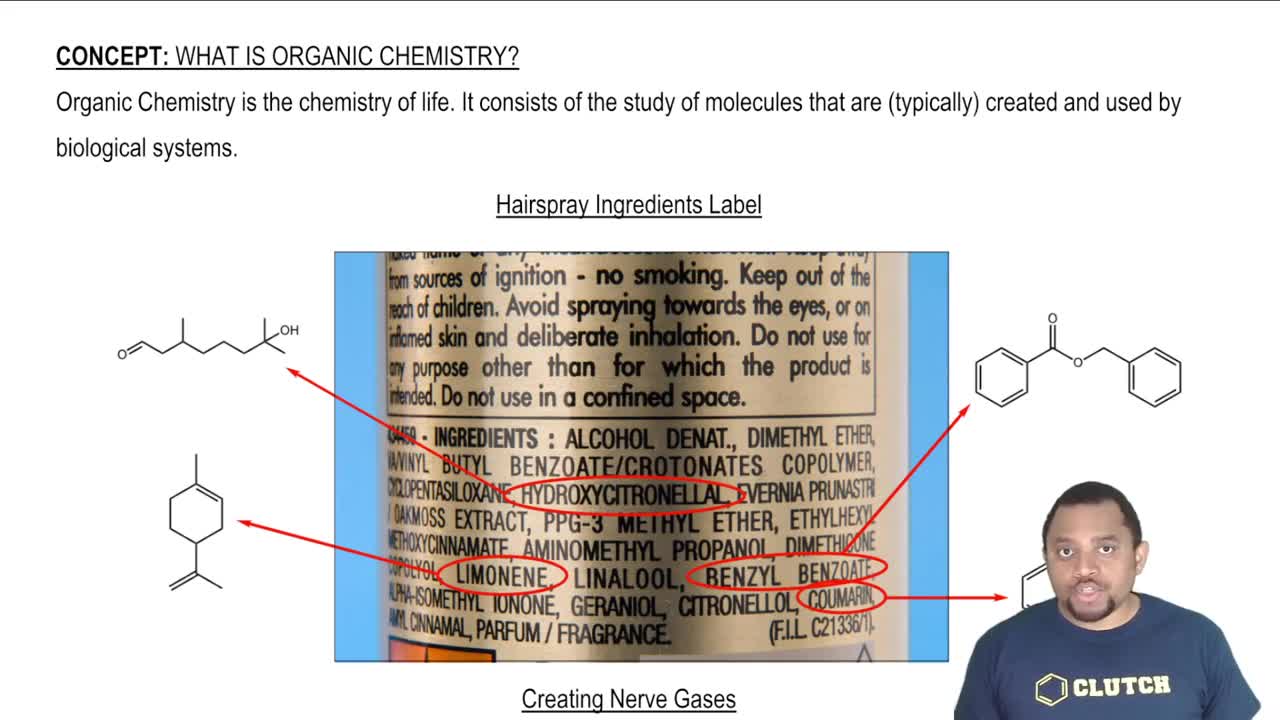
Organic molecules in your everyday life.
관련 실천
교과서 질문

The following reaction has a value of ΔG° = –2.1 kJ/mol (–0.50 kcal/mol).

CH3Br + H2S ⇌ CH3SH + HBr

b. Starting with a 1 M solution of CH3Br and H2S, calculate the final concentrations of all four species at equilibrium.

1565
views

교과서 질문

Use the bond-dissociation enthalpies in Table 4-2 (page 167) to calculate the heats of reaction for the two possible first propagation steps in the chlorination of isobutane. Use this information to draw a reaction-energy diagram like Figure 4-8, comparing the activation energies for formation of the two radicals.

1047
views
교과서 질문

Under base-catalyzed conditions, two molecules of acetone can condense to form diacetone alcohol. At room temperature (25 °C), about 5% of the acetone is converted to diacetone alcohol. Determine the value of ΔG° for this reaction.

1269
views
교과서 질문

The following reaction has a value of ΔG° = –2.1 kJ/mol (–0.50 kcal/mol).

CH3Br + H2S ⇌ CH3SH + HBr

a. Calculate Keq at room temperature (25 °C) for this reaction as written.

1856
views
교과서 질문
The reaction of tert-butyl chloride with methanol (CH3)3C—Cl Tert-butylchloride + CH3—OH methanol —> (CH3)C—OCH3 methyltert-butylether + HCl is found to follow the rate equation rate= Kr[(CH3)3C—Cl] c. What is the kinetic order overall?
698
views
교과서 질문
The bromination of methane proceeds through the following steps: 1. Br2 + 2 Br• ΔH° (per mole)/+190 kJ (45 kcal) Ea (per mole)/ 190 kJ (45 kcal) 2. CH4 + Br• —> CH3+ HBr +73 kJ (17 kcal) 79 kJ (19 kcal) 3. • CH3 + Br2 —> CH3Br + Br -112 kJ (-27 kcal) 4 kJ (1 kcal) a. Draw a complete reaction-energy diagram for this reaction. b. Label the rate-limiting step.
3508
views