Ch.4 - The Study of Chemical Reactions
Wade - Organic Chemistry 9th Edition
Wade9th EditionOrganic ChemistryISBN: 9780135213728당신이 사용하는 게 아니라요?교과서 변경
4장, 문제 41c

Use bond-dissociation enthalpies (Table 4-2, p. 167) to calculate values of ΔH° for the following reactions.
c. (CH3)3C—OH + HCl → (CH3)3C—Cl + H2O

검증된 단계별 안내
1
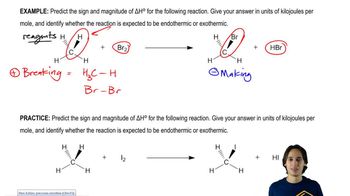
Identify the bonds broken and formed in the reaction. In this case, the bonds broken are the O-H bond in (CH3)3C—OH and the H-Cl bond in HCl. The bonds formed are the C-Cl bond in (CH3)3C—Cl and the O-H bond in H2O.
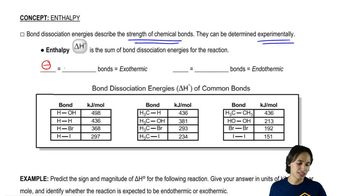
Look up the bond-dissociation enthalpies (BDEs) for each bond involved in the reaction. These values can be found in Table 4-2 on page 167. For example, the BDE for the O-H bond, H-Cl bond, C-Cl bond, and O-H bond in water should be noted.
Calculate the total energy required to break the bonds. This is done by summing the BDEs of the bonds broken: BDE(O-H in (CH3)3C—OH) + BDE(H-Cl).
Calculate the total energy released when the new bonds are formed. This is done by summing the BDEs of the bonds formed: BDE(C-Cl in (CH3)3C—Cl) + BDE(O-H in H2O).
Determine the enthalpy change (ΔH°) for the reaction by subtracting the total energy of the bonds formed from the total energy of the bonds broken: ΔH° = [Sum of BDEs of bonds broken] - [Sum of BDEs of bonds formed].

비슷한 문제에 대한 검증된 영상 답변:

이 영상 해법은 위 문제에 도움이 된다고 튜터들이 추천한 것입니다.
영상 길이:
4m

주요 개념

질문에 올바르게 답하기 위해 반드시 이해해야 하는 핵심 개념들은 다음과 같습니다.

Bond-Dissociation Enthalpy

Bond-dissociation enthalpy (BDE) is the energy required to break a specific bond in a molecule, resulting in the formation of free radicals. It is a crucial concept in thermodynamics and organic chemistry, as it helps predict the stability of molecules and the energy changes during chemical reactions. BDE values are typically provided in kilojoules per mole (kJ/mol) and vary depending on the type of bond and the molecular environment.
추천 영상:
04:09
How to calculate enthalpy using bond dissociation energies.

Enthalpy Change (ΔH°)

Enthalpy change (ΔH°) refers to the heat content change of a system at constant pressure during a chemical reaction. It can be calculated using the bond-dissociation enthalpies of the reactants and products. A negative ΔH° indicates that the reaction is exothermic (releases heat), while a positive ΔH° indicates an endothermic reaction (absorbs heat). Understanding ΔH° is essential for predicting reaction feasibility and energy requirements.
추천 영상:
04:38
Calculating Enthalpies

Reaction Mechanism

A reaction mechanism describes the step-by-step sequence of elementary reactions by which overall chemical change occurs. It provides insight into how reactants transform into products, including the formation and breaking of bonds. In the context of the given reaction, understanding the mechanism helps in identifying the bonds involved and calculating the ΔH° accurately by considering the specific bonds broken and formed during the reaction.
추천 영상:
02:16
Heck Reaction Mechanism