Ch.4 - The Study of Chemical Reactions
Wade - Organic Chemistry 9th Edition
Wade9th EditionOrganic ChemistryISBN: 9780135213728당신이 사용하는 게 아니라요?교과서 변경
4장, 문제 18

What would be the product ratio in the chlorination of propane if all the hydrogens were abstracted at equal rates?

검증된 단계별 안내
1
Identify the types of hydrogens in propane. Propane (C3H8) has two types of hydrogens: primary hydrogens (attached to the terminal carbons) and secondary hydrogens (attached to the central carbon).
Count the number of each type of hydrogen. Propane has 6 primary hydrogens (3 on each terminal carbon) and 2 secondary hydrogens (on the central carbon).
Assume that all hydrogens are abstracted at equal rates, meaning there is no preference for primary or secondary hydrogens during the chlorination process.
Determine the product ratio based on the number of hydrogens available for abstraction. The ratio of products will correspond to the ratio of primary to secondary hydrogens, which is 6:2 or 3:1.
Conclude that the product ratio will reflect the statistical likelihood of abstraction, resulting in a 3:1 ratio of chlorinated products derived from primary and secondary hydrogens, respectively.

비슷한 문제에 대한 검증된 영상 답변:

이 영상 해법은 위 문제에 도움이 된다고 튜터들이 추천한 것입니다.
영상 길이:
3m

주요 개념

질문에 올바르게 답하기 위해 반드시 이해해야 하는 핵심 개념들은 다음과 같습니다.

Radical Halogenation

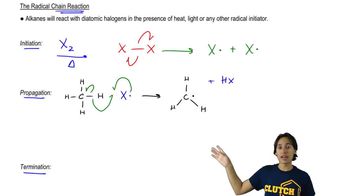
Radical halogenation is a reaction where alkanes react with halogens (like chlorine) in the presence of heat or light to form alkyl halides. This process involves the formation of free radicals, which are highly reactive species with unpaired electrons. The reaction proceeds through initiation, propagation, and termination steps, leading to the substitution of hydrogen atoms by halogen atoms.
추천 영상:
12:11
Radical Chain Reaction Mechanism.

Product Distribution

In the chlorination of propane, the product distribution refers to the ratio of different alkyl halides formed, which depends on the stability of the resulting radicals. Propane can form primary, secondary, and tertiary radicals, with secondary radicals being more stable than primary ones. If all hydrogen atoms are abstracted at equal rates, the product ratio will reflect the relative stabilities of these radicals.
추천 영상:
11:07
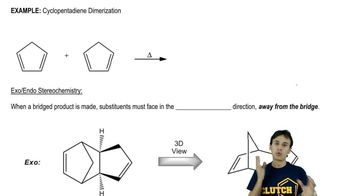
Bridged-Products

Statistical Distribution

Statistical distribution in this context refers to the likelihood of each hydrogen atom being abstracted during the chlorination process. If all hydrogens are abstracted at equal rates, the resulting product ratio can be predicted based on the number of each type of hydrogen in propane. This leads to a specific ratio of products, which can be calculated based on the number of equivalent hydrogen atoms in primary, secondary, and tertiary positions.
추천 영상:
02:46
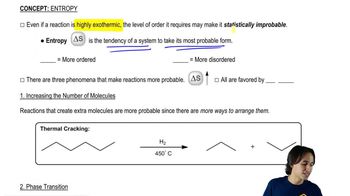
Explaining what entropy is.