Ch. 7 - Structure and Synthesis of Alkenes; Elimination
Wade - Organic Chemistry 9th Edition
Wade9th EditionOrganic ChemistryISBN: 9780135213728당신이 사용하는 게 아니라요?교과서 변경
7장, 문제 63d

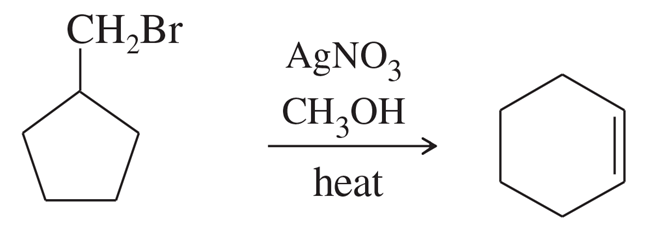
Silver-assisted solvolysis of bromomethylcyclopentane in methanol gives a complex product mixture of the following five compounds. Propose mechanisms to account for these products.
(d)

검증된 단계별 안내
1
Step 1: Recognize the reaction conditions. The presence of AgNO₃ and CH₃OH under heat suggests a silver-assisted solvolysis reaction. Silver ions (Ag⁺) can facilitate the departure of the bromide ion (Br⁻) from bromomethylcyclopentane, forming a carbocation intermediate.
Step 2: Identify the carbocation intermediate. The loss of Br⁻ from bromomethylcyclopentane generates a cyclopentylmethyl carbocation. This carbocation is relatively stable due to hyperconjugation and inductive effects.
Step 3: Consider possible rearrangements. The cyclopentylmethyl carbocation can undergo a hydride shift or ring expansion to form a more stable carbocation, such as a cyclohexyl carbocation. This rearrangement is driven by the stability of the six-membered ring structure.
Step 4: Analyze nucleophilic attack by methanol (CH₃OH). Methanol can act as a nucleophile and attack the carbocation, leading to the formation of methoxy-substituted products. Additionally, elimination reactions can occur, forming alkenes such as cyclohexene.
Step 5: Account for the product mixture. The reaction can yield a variety of products, including methoxycyclopentane, methoxycyclohexane, cyclohexene, and other rearranged or substituted compounds. Each product arises from different pathways involving carbocation rearrangements, nucleophilic substitution, and elimination.

비슷한 문제에 대한 검증된 영상 답변:

이 영상 해법은 위 문제에 도움이 된다고 튜터들이 추천한 것입니다.
영상 길이:
3m

주요 개념

질문에 올바르게 답하기 위해 반드시 이해해야 하는 핵심 개념들은 다음과 같습니다.

Silver-Assisted Solvolysis

Silver-assisted solvolysis involves the use of silver salts, such as AgNO3, to facilitate the nucleophilic substitution of a leaving group (like bromine) in an organic compound. In this reaction, the silver ion helps to stabilize the leaving group, promoting the formation of a carbocation intermediate, which can then react with the solvent (methanol) to form various products.
추천 영상:
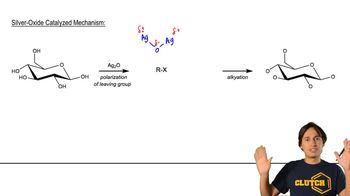
03:02
Silver Oxide Catalyzed Mechanism

Nucleophilic Substitution Mechanisms

Nucleophilic substitution mechanisms, primarily SN1 and SN2, describe how nucleophiles attack electrophiles to replace a leaving group. In SN1 reactions, a carbocation is formed as an intermediate, allowing for rearrangements and the possibility of multiple products. In contrast, SN2 reactions involve a direct attack by the nucleophile, leading to a single product without intermediates.
추천 영상:
01:47
Nucleophiles and Electrophiles can react in Substitution Reactions.

Product Mixture and Rearrangements

The formation of a complex product mixture in reactions like the one described can result from various pathways, including rearrangements of carbocations. When a carbocation is formed, it may undergo shifts to more stable forms, leading to different structural isomers. This complexity is particularly evident in cyclic compounds, where ring strain and stability can influence the final product distribution.
추천 영상:
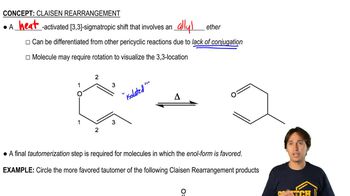
06:08
Definition of Claisen Rearrangement