Ch. 7 - Structure and Synthesis of Alkenes; Elimination
Wade - Organic Chemistry 9th Edition
Wade9th EditionOrganic ChemistryISBN: 9780135213728당신이 사용하는 게 아니라요?교과서 변경
7장, 문제 19

The solvolysis of 2-bromo-3-methylbutane potentially can give several products, ­including both E1 and products from both the unrearranged carbocation and the rearranged ­carbocation. Mechanisms 6-6 and 7-2 show the products from the rearranged carbocation. Summarize all the possible products, showing which carbocation they come from and whether they are the products of E1 or reactions.
<IMAGES>

검증된 단계별 안내
1
Step 1: Understand the solvolysis reaction mechanism. Solvolysis typically involves the substitution or elimination of a leaving group (in this case, bromine) in the presence of a solvent. For 2-bromo-3-methylbutane, the reaction proceeds via a carbocation intermediate, which can undergo rearrangement.
Step 2: Identify the initial carbocation formed. When the bromine leaves, the molecule forms a secondary carbocation at the 2-position. This carbocation is prone to rearrangement to form a more stable tertiary carbocation at the 3-position.
Step 3: Determine the products from the unrearranged carbocation. The secondary carbocation can undergo elimination (E1 mechanism) to form an alkene, specifically 2-methyl-2-butene. Alternatively, it can undergo substitution to form a solvolysis product, such as 2-methoxy-3-methylbutane if methanol is the solvent.
Step 4: Determine the products from the rearranged carbocation. The tertiary carbocation formed after rearrangement can also undergo elimination (E1 mechanism) to form alkenes, such as 2-methyl-2-butene and 2-methyl-1-butene. Additionally, it can undergo substitution to form solvolysis products, such as 3-methoxy-3-methylbutane if methanol is the solvent.
Step 5: Summarize the possible products. From the unrearranged carbocation, you get products like 2-methyl-2-butene (E1) and 2-methoxy-3-methylbutane (substitution). From the rearranged carbocation, you get products like 2-methyl-2-butene and 2-methyl-1-butene (E1) and 3-methoxy-3-methylbutane (substitution).

비슷한 문제에 대한 검증된 영상 답변:

이 영상 해법은 위 문제에 도움이 된다고 튜터들이 추천한 것입니다.
영상 길이:
3m

주요 개념

질문에 올바르게 답하기 위해 반드시 이해해야 하는 핵심 개념들은 다음과 같습니다.

Solvolysis

Solvolysis is a type of nucleophilic substitution reaction where a solvent acts as the nucleophile. In the case of 2-bromo-3-methylbutane, the solvent (often water or alcohol) attacks the carbon atom bonded to the leaving group (bromine), leading to the formation of various products. This process can proceed via different mechanisms, including E1 and SN1, depending on the stability of the carbocation formed.
추천 영상:
08:16
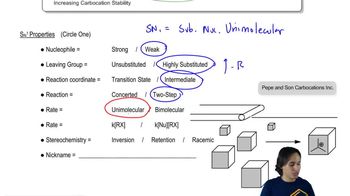
Understanding the properties of SN1.

Carbocation Rearrangement

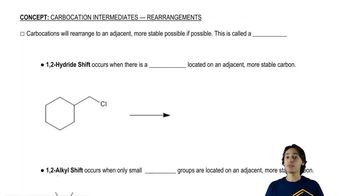
Carbocation rearrangement occurs when a carbocation intermediate shifts to a more stable form during a reaction. In the case of 2-bromo-3-methylbutane, the initial carbocation can rearrange to a more stable tertiary carbocation, which can lead to different products. Understanding the stability of carbocations is crucial for predicting the outcome of solvolysis reactions.
추천 영상:
00:47
Understanding why carbocations shift.

E1 Mechanism

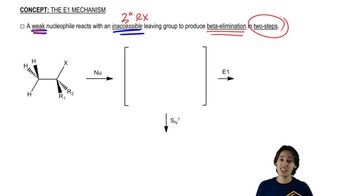
The E1 mechanism is a type of elimination reaction that involves the formation of a carbocation intermediate followed by the loss of a proton to form an alkene. In the context of 2-bromo-3-methylbutane, the E1 pathway can yield alkenes from both the rearranged and unrearranged carbocations. The rate of the E1 reaction depends on the stability of the carbocation and the solvent used.
추천 영상:
08:09
Drawing the E1 Mechanism.