Ch.8 - Reactions of Alkenes
Wade - Organic Chemistry 9th Edition
Wade9th EditionOrganic ChemistryISBN: 9780135213728당신이 사용하는 게 아니라요?교과서 변경
8장, 문제 2a

When 1 mole of buta-1,3-diene reacts with 1 mole of HBr, both 3-bromobut-1-ene and 1-bromobut-2-ene are formed. Propose a mechanism to account for this mixture of products.

검증된 단계별 안내
1
Identify the structure of buta-1,3-diene (CH₂=CH-CH=CH₂) and recognize that it is a conjugated diene, which allows for resonance stabilization of intermediates during the reaction.
Understand that the reaction with HBr proceeds via an electrophilic addition mechanism. The first step involves the protonation of one of the double bonds in buta-1,3-diene by H⁺ from HBr, forming a carbocation intermediate.
Recognize that the carbocation intermediate formed can undergo resonance stabilization. Write the two resonance structures: one where the positive charge is on the second carbon (CH₃-CH⁺-CH=CH₂) and another where the positive charge is on the fourth carbon (CH₂=CH-CH⁺-CH₃).
Explain that the bromide ion (Br⁻) can attack either of the carbocation intermediates. Attack on the carbocation at the second carbon leads to the formation of 3-bromobut-1-ene, while attack on the carbocation at the fourth carbon leads to the formation of 1-bromobut-2-ene.
Conclude that the mixture of products arises because the reaction proceeds through a resonance-stabilized carbocation intermediate, allowing for multiple sites of nucleophilic attack by Br⁻, leading to the observed regioisomers.

비슷한 문제에 대한 검증된 영상 답변:

이 영상 해법은 위 문제에 도움이 된다고 튜터들이 추천한 것입니다.
영상 길이:
9m

주요 개념

질문에 올바르게 답하기 위해 반드시 이해해야 하는 핵심 개념들은 다음과 같습니다.

Electrophilic Addition

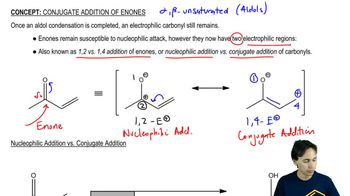
Electrophilic addition is a fundamental reaction mechanism in organic chemistry where an electrophile reacts with a nucleophile, leading to the formation of a more saturated product. In the case of buta-1,3-diene and HBr, the double bonds in the diene act as nucleophiles, attacking the electrophilic hydrogen in HBr, resulting in the formation of a carbocation intermediate.
추천 영상:
09:23
1,2 vs 1,4 Addition

Carbocation Stability

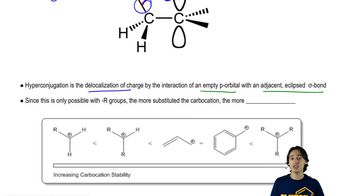
Carbocation stability is crucial in determining the outcome of reactions involving electrophilic addition. The stability of a carbocation is influenced by its degree (primary, secondary, or tertiary) and the presence of adjacent double bonds or electron-donating groups. In this reaction, the formation of both 3-bromobut-1-ene and 1-bromobut-2-ene can be explained by the stability of the carbocations formed during the addition of HBr to buta-1,3-diene.
추천 영상:
05:58
Determining Carbocation Stability

Markovnikov's Rule

Markovnikov's Rule states that in the addition of HX to an alkene, the hydrogen atom will attach to the carbon with the greater number of hydrogen atoms already attached, leading to the more stable product. In the reaction of buta-1,3-diene with HBr, this rule helps explain why both 3-bromobut-1-ene and 1-bromobut-2-ene are formed, as the reaction can proceed through different pathways depending on the stability of the intermediates.
추천 영상:
03:54
The 18 and 16 Electron Rule