



Ch.8 - Reactions of Alkenes
Wade - Organic Chemistry 9th Edition
Wade9th EditionOrganic ChemistryISBN: 9780135213728당신이 사용하는 게 아니라요?교과서 변경
8장, 문제 55b,c,d

Complete each synthesis by providing the structure of the major product at each step, including any important stereochemistry.
b.
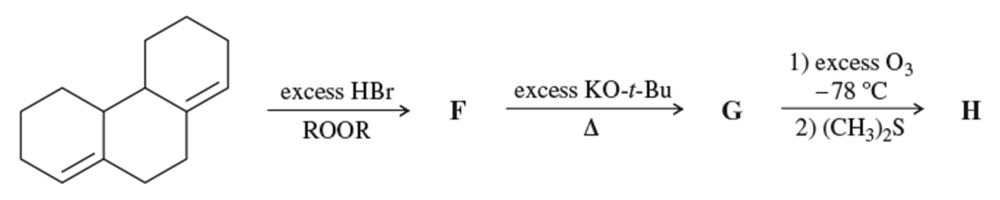
c.
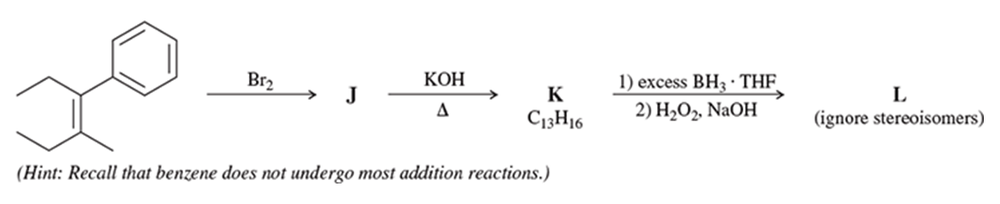
d.

검증된 단계별 안내
1
Step 1: Analyze the reaction sequence for part b. The first step involves oxymercuration-demercuration using Hg(OAc)₂, H₂O, and NaBH₄. This reaction adds water across the double bond in a Markovnikov fashion, forming an alcohol as the major product.
Step 2: The second step in part b involves acid-catalyzed dehydration using H₂SO₄. This converts the alcohol into an alkene via elimination, forming the more substituted alkene as the major product.
Step 3: The third step in part b involves dihydroxylation using OsO₄ and H₂O₂. This reaction adds two hydroxyl groups to the alkene in a syn fashion, forming a vicinal diol.
Step 4: For part c, the first step involves radical addition of HBr in the presence of ROOR. This reaction adds HBr to the double bond in an anti-Markovnikov fashion, forming a brominated product.
Step 5: The second step in part c involves elimination using KO-t-Bu and heat. This reaction removes HBr, forming an alkyne. Subsequent ozonolysis with O₃ and (CH₃)₂S cleaves the triple bond, forming carboxylic acids or ketones depending on the structure.

비슷한 문제에 대한 검증된 영상 답변:

이 영상 해법은 위 문제에 도움이 된다고 튜터들이 추천한 것입니다.
영상 길이:
14m

주요 개념

질문에 올바르게 답하기 위해 반드시 이해해야 하는 핵심 개념들은 다음과 같습니다.

Hydration of Alkenes

The hydration of alkenes involves the addition of water across a double bond, typically catalyzed by acids. In this reaction, the alkene is converted into an alcohol. The mechanism often follows Markovnikov's rule, where the more substituted carbon atom receives the hydroxyl group, leading to the formation of a more stable carbocation intermediate.
추천 영상:
09:11
Alkyne Hydration

Reduction Reactions

Reduction reactions in organic chemistry refer to the gain of electrons or hydrogen, or the loss of oxygen. In the context of the provided synthesis, sodium borohydride (NaBH4) is used to reduce the carbonyl compound formed during hydration to an alcohol. This step is crucial for converting the intermediate product into a more stable and functionalized alcohol.
추천 영상:
07:12
Reductive Amination

Dihydroxylation

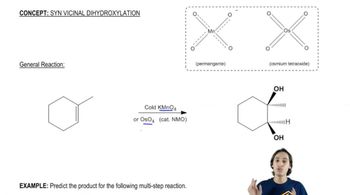
Dihydroxylation is the addition of two hydroxyl groups (-OH) to a double bond, resulting in a vicinal diol. The reaction can be achieved using osmium tetroxide (OsO4) in the presence of hydrogen peroxide (H2O2), which provides a syn addition mechanism. This step is important for introducing stereochemistry into the product, as it can lead to specific configurations in the final compound.
추천 영상:
03:50
General properties of syn vicinal dihydroxylation.