Ch.8 - Reactions of Alkenes
Wade - Organic Chemistry 9th Edition
Wade9th EditionOrganic ChemistryISBN: 9780135213728당신이 사용하는 게 아니라요?교과서 변경
8장, 문제 36b

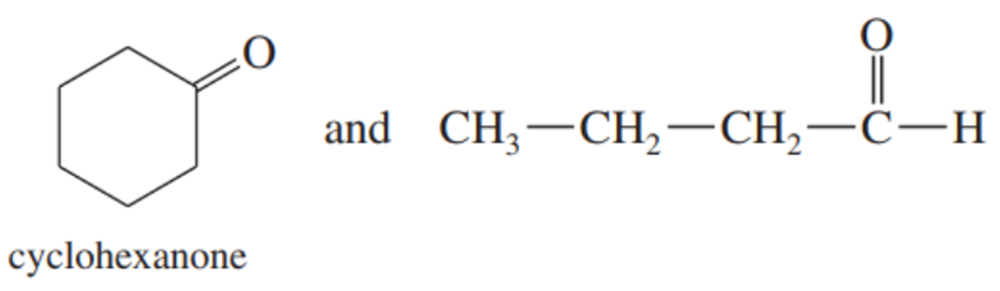
Give structures of the alkenes that would give the following products upon ozonolysis–reduction.
(b)

검증된 단계별 안내
1
Step 1: Understand the ozonolysis reaction. Ozonolysis is a reaction where an alkene reacts with ozone (O₃) to form an ozonide intermediate, which is then reduced (commonly using zinc and water or dimethyl sulfide) to yield carbonyl compounds such as aldehydes and ketones.
Step 2: Analyze the given products. In part (b), the products are cyclohexanone (a ketone) and butanal (an aldehyde). These are the carbonyl compounds formed after ozonolysis-reduction.
Step 3: Determine the original alkene structure. The products suggest that the original alkene was cleaved at the double bond to yield these two fragments. Cyclohexanone indicates that one part of the alkene was a cyclohexane ring with a double bond, while butanal suggests the other part was a straight-chain alkene fragment.
Step 4: Reconstruct the alkene. To form cyclohexanone and butanal upon ozonolysis, the original alkene must have had a double bond connecting the cyclohexane ring to the butyl group (CH₃CH₂CH₂CH=). The double bond is cleaved during ozonolysis to yield the two products.
Step 5: Verify the structure. The reconstructed alkene is cyclohexylbutene, specifically 1-cyclohexyl-1-butene. This structure ensures that ozonolysis produces cyclohexanone and butanal as the products.

비슷한 문제에 대한 검증된 영상 답변:

이 영상 해법은 위 문제에 도움이 된다고 튜터들이 추천한 것입니다.
영상 길이:
6m

주요 개념

질문에 올바르게 답하기 위해 반드시 이해해야 하는 핵심 개념들은 다음과 같습니다.

Ozonolysis

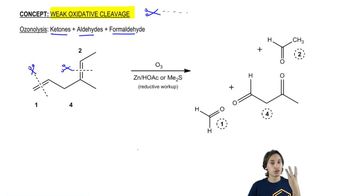
Ozonolysis is a reaction involving the cleavage of alkenes using ozone (O3) to form carbonyl compounds. The process typically occurs in two steps: first, the alkene reacts with ozone to form a molozonide, which rearranges to form ozonide. The ozonide is then reduced, often using zinc and acetic acid or dimethyl sulfide, yielding aldehydes or ketones as products.
추천 영상:
06:30
General properties of ozonolysis.

Alkenes

Alkenes are hydrocarbons that contain at least one carbon-carbon double bond (C=C). They are unsaturated compounds and can undergo various reactions, including addition and polymerization. The position and substitution of the double bond in alkenes significantly influence the products formed during reactions such as ozonolysis.
추천 영상:
가이드 코스
2:09
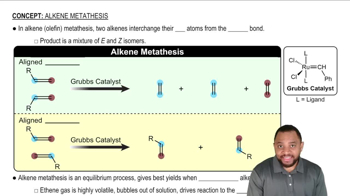
Alkene Metathesis Concept 1

Reduction of Carbonyl Compounds

The reduction of carbonyl compounds involves the addition of hydrogen or the removal of oxygen, converting ketones or aldehydes into alcohols. Common reducing agents include lithium aluminum hydride (LiAlH4) and sodium borohydride (NaBH4). In the context of ozonolysis, the reduction step is crucial for transforming the carbonyl products into more stable alcohols or other functional groups.
추천 영상:
01:40
Defining meso compounds.