Ch.8 - Reactions of Alkenes
Wade - Organic Chemistry 9th Edition
Wade9th EditionOrganic ChemistryISBN: 9780135213728당신이 사용하는 게 아니라요?교과서 변경
8장, 문제 32b,c

Predict the major products of the following reactions.
b. trans-hex-3-ene + peroxyacetic acid (CH3CO3H) in water
c. 1-methylcyclohexene + MMPP in ethanol

검증된 단계별 안내
1
Step 1: Recognize the type of reaction occurring in each case. Both reactions involve the addition of an epoxide group to an alkene. Peroxyacids (CH3CO3H and MMPP) are used to convert alkenes into epoxides via electrophilic addition.
Step 2: For reaction b (trans-hex-3-ene + CH3CO3H in water), note that the trans-alkene geometry will influence the stereochemistry of the epoxide product. The reaction proceeds via a concerted mechanism, preserving the stereochemistry of the starting alkene. The trans-hex-3-ene will yield a trans-epoxide.
Step 3: For reaction c (1-methylcyclohexene + MMPP in ethanol), the cyclic structure of 1-methylcyclohexene will result in the formation of a single epoxide product. The methyl group on the cyclohexene ring does not affect the regioselectivity of the epoxidation, as the reaction occurs at the double bond.
Step 4: Consider the solvent effects. In reaction b, water may facilitate hydrolysis of the epoxide under acidic or basic conditions, potentially leading to diol formation. However, the major product is the epoxide unless hydrolysis is explicitly stated. In reaction c, ethanol does not significantly alter the epoxidation mechanism.
Step 5: Draw the major products for each reaction. For reaction b, the product is trans-hex-3-ene epoxide. For reaction c, the product is 1-methylcyclohexene epoxide. Ensure stereochemistry is correctly represented in the structures.

비슷한 문제에 대한 검증된 영상 답변:

이 영상 해법은 위 문제에 도움이 된다고 튜터들이 추천한 것입니다.
영상 길이:
7m

주요 개념

질문에 올바르게 답하기 위해 반드시 이해해야 하는 핵심 개념들은 다음과 같습니다.

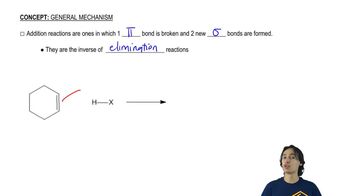
Electrophilic Addition Reactions

Electrophilic addition reactions involve the addition of an electrophile to a nucleophile, typically across a double bond. In the case of alkenes, the π bond is broken, allowing for the formation of new σ bonds. Understanding this mechanism is crucial for predicting the products of reactions involving alkenes, such as the reaction of trans-hex-3-ene with peroxyacetic acid.
추천 영상:
05:39
Features of Addition Mechanisms.

Peroxyacetic Acid as an Oxidizing Agent

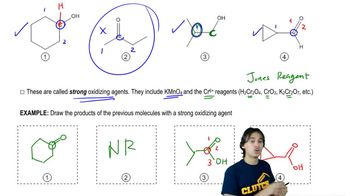
Peroxyacetic acid (CH3CO3H) is a peracid that can act as an oxidizing agent in organic reactions. It is commonly used to convert alkenes into epoxides or to perform oxidation reactions. Recognizing its role in the reaction with trans-hex-3-ene helps in predicting the formation of epoxide products and subsequent hydrolysis in water.
추천 영상:
05:53
Strong oxidizing agents

MMPP and its Role in Organic Synthesis

MMPP (m-chloroperbenzoic acid) is a reagent used for the oxidation of alkenes to form epoxides or for other transformations. In the reaction with 1-methylcyclohexene, MMPP facilitates the formation of an epoxide intermediate, which can lead to various products depending on the reaction conditions. Understanding MMPP's reactivity is essential for predicting the outcomes of the reaction in ethanol.
추천 영상:
가이드 코스
1:16
Synthesis of Amino Acids: Strecker Synthesis Example 1
관련 실천