


When (E)-3-methylhex-3-ene undergoes hydroboration–oxidation, two isomeric products are formed. Give their structures, and label each asymmetric carbon atom as (R) or (S). What is the relationship between these isomers? What is the relationship between the products formed from (Z)-3-methylhex-3-ene and those formed from (E)-3-methylhex-3-ene?
Predict the major products of the following reactions. Include stereochemistry where applicable.
(c) 
검증된 단계별 안내
비슷한 문제에 대한 검증된 영상 답변:
주요 개념
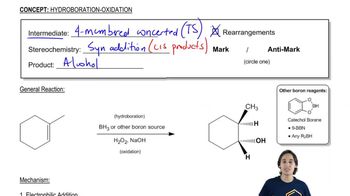
Hydroboration-Oxidation
Stereochemistry
Regioselectivity
Show how you would accomplish the following transformations.
(a)
Predict the major products of the following reactions. Include stereochemistry where applicable.
(a) 1−methylcyclohexene + BH3⋅THF then H2O2, OH–
In the hydroboration of 1-methylcyclopentene shown in Solved Problem 8-3, the reagents are achiral, and the products are chiral. The product is a racemic mixture of trans-2-methylcyclopentanol, but only one enantiomer is shown. Show how the other enantiomer is formed.
Predict the major products of the following reactions. Include stereochemistry where applicable.
(b) trans-4,4-dimethylpent-2-ene + BH3⋅THF then H2O2, OH–
When (Z)-3-methylhex-3-ene undergoes hydroboration–oxidation, two isomeric products are formed. Give their structures, and label each asymmetric carbon atom as (R) or (S). What is the relationship between these isomers?
