

Ch.8 - Reactions of Alkenes
Wade - Organic Chemistry 9th Edition
Wade9th EditionOrganic ChemistryISBN: 9780135213728당신이 사용하는 게 아니라요?교과서 변경
8장, 문제 4d

Show how you would accomplish the following synthetic conversions.
(d) 2−methylbutan-2-ol → 2-bromo-3-methylbutane

검증된 단계별 안내
1
Step 1: Identify the functional group in the starting material, 2-methylbutan-2-ol. It contains a tertiary alcohol (-OH group attached to a tertiary carbon). This is important because tertiary alcohols undergo substitution reactions readily under acidic conditions.
Step 2: Recognize that the target molecule, 2-bromo-3-methylbutane, requires the replacement of the hydroxyl (-OH) group with a bromine atom (Br). This suggests a substitution reaction mechanism.
Step 3: Select an appropriate reagent for the substitution reaction. Use hydrobromic acid (HBr) as the reagent, as it is commonly used to convert alcohols to alkyl bromides via an SN1 mechanism. The tertiary alcohol will form a stable carbocation intermediate during the reaction.
Step 4: Write the reaction mechanism. The hydroxyl group is protonated by HBr, forming water as a leaving group. This generates a tertiary carbocation intermediate. Bromide ion (Br⁻) then attacks the carbocation, resulting in the formation of 2-bromo-3-methylbutane.
Step 5: Verify the stereochemistry and structure of the product. Since the reaction proceeds via an SN1 mechanism, the product may be racemic if the carbocation intermediate is chiral. However, in this case, the product is achiral, so stereochemistry is not a concern.

비슷한 문제에 대한 검증된 영상 답변:

이 영상 해법은 위 문제에 도움이 된다고 튜터들이 추천한 것입니다.
영상 길이:
2m

주요 개념

질문에 올바르게 답하기 위해 반드시 이해해야 하는 핵심 개념들은 다음과 같습니다.

Alcohols and Their Reactivity

Alcohols, such as 2-methylbutan-2-ol, are organic compounds containing a hydroxyl (-OH) group. Their reactivity is influenced by the structure of the alcohol, including whether it is primary, secondary, or tertiary. In this case, 2-methylbutan-2-ol is a tertiary alcohol, which can undergo substitution reactions to form alkyl halides.
추천 영상:
01:01
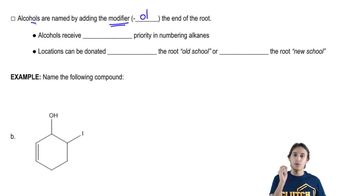
How to name alcohols

Nucleophilic Substitution Reactions

Nucleophilic substitution reactions involve the replacement of a leaving group (like -OH in alcohols) with a nucleophile (such as Br-). In the conversion of 2-methylbutan-2-ol to 2-bromo-3-methylbutane, the hydroxyl group is replaced by a bromine atom through an SN1 or SN2 mechanism, depending on the conditions and substrate structure.
추천 영상:
01:47
Nucleophiles and Electrophiles can react in Substitution Reactions.

Stereochemistry and Isomerism

Stereochemistry refers to the spatial arrangement of atoms in molecules and is crucial in organic synthesis. The conversion from 2-methylbutan-2-ol to 2-bromo-3-methylbutane may lead to different stereoisomers, depending on the reaction pathway. Understanding how to manage stereochemistry is essential for predicting the outcome of synthetic reactions.
추천 영상:
가이드 코스
1:38
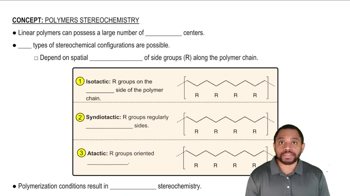
Polymer Stereochemistry Concept 1