
Ch.8 - Reactions of Alkenes
Wade - Organic Chemistry 9th Edition
Wade9th EditionOrganic ChemistryISBN: 9780135213728당신이 사용하는 게 아니라요?교과서 변경
8장, 문제 62

The sex attractant of the housefly has the formula C23H46. When treated with warm potassium permanganate, this pheromone gives two products: CH3(CH2)12COOH and CH3(CH2)7COOH. Suggest a structure for this sex attractant. Explain which part of the structure is uncertain.

검증된 단계별 안내
1
Step 1: Analyze the given information. The sex attractant has the molecular formula C23H46, and upon oxidation with warm potassium permanganate, it produces two carboxylic acids: CH3(CH2)12COOH and CH3(CH2)7COOH. This suggests that the original molecule contains a double bond that is cleaved during the oxidation reaction.
Step 2: Recall the mechanism of oxidative cleavage of alkenes by potassium permanganate. When an alkene is treated with warm KMnO4, the double bond is broken, and each carbon of the double bond is converted into a carboxylic acid group if it is bonded to hydrogen atoms. This indicates that the sex attractant contains a double bond in its structure.
Step 3: Deduce the positions of the double bond based on the products formed. The two carboxylic acids produced have chain lengths of 13 carbons (CH3(CH2)12COOH) and 8 carbons (CH3(CH2)7COOH). This implies that the double bond is located between the 13th and 14th carbon atoms in the original C23H46 molecule.
Step 4: Propose a structure for the sex attractant. Based on the cleavage pattern, the molecule likely has a long hydrocarbon chain with a single double bond between the 13th and 14th carbons. The structure can be represented as CH3(CH2)12CH=CH(CH2)7CH3.
Step 5: Address the uncertainty in the structure. The exact stereochemistry (cis or trans configuration) of the double bond is not specified in the problem. This is an important aspect of the structure that remains uncertain and would require additional experimental data, such as spectroscopic analysis, to determine.

비슷한 문제에 대한 검증된 영상 답변:

이 영상 해법은 위 문제에 도움이 된다고 튜터들이 추천한 것입니다.
영상 길이:
10m

주요 개념

질문에 올바르게 답하기 위해 반드시 이해해야 하는 핵심 개념들은 다음과 같습니다.

Molecular Formula Interpretation

The molecular formula C23H46 indicates that the compound consists of 23 carbon atoms and 46 hydrogen atoms. This formula suggests that the compound is likely a long-chain hydrocarbon, possibly with functional groups. Understanding how to interpret molecular formulas is crucial for deducing the structure and properties of organic compounds.
추천 영상:
02:17
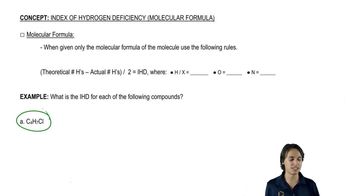
How to use IHD with molecular formula.

Oxidation Reactions

The reaction with warm potassium permanganate indicates an oxidation process, where the alkene or alkane is converted into carboxylic acids. The products, CH3(CH2)12COOH and CH3(CH2)7COOH, suggest that the original compound likely contained double bonds or branched structures that were oxidized. Recognizing the types of reactions and their outcomes is essential for predicting product structures.
추천 영상:
03:20
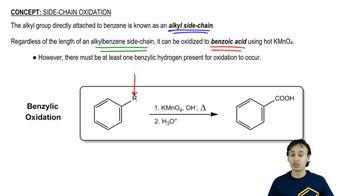
Benzylic Oxidation

Structural Isomerism

The presence of two different carboxylic acids as products implies that the original sex attractant may have structural isomers. Structural isomerism occurs when compounds have the same molecular formula but different arrangements of atoms. Identifying which part of the structure is uncertain involves analyzing where the double bonds or branching may exist, leading to different isomeric forms.
추천 영상:
06:47
Monosaccharides - D and L Isomerism
관련 실천
교과서 질문

Cyclohexene is dissolved in a solution of lithium chloride in chloroform. To this solution is added one equivalent of bromine. The material isolated from this reaction contains primarily a mixture of trans-1,2-dibromocyclohexane and trans-1-bromo-2-chlorocyclohexane. Propose a mechanism to show how these compounds are formed.

1140
views
교과서 질문

The two butenedioic acids are called fumaric acid (trans) and maleic acid (cis). 2,3-Dihydroxybutanedioic acid is called tartaric acid.

Show how you would convert

a. fumaric acid to (±)-tartaric acid.

b. fumaric acid to meso-tartaric acid.

844
views
교과서 질문

One of the constituents of turpentine is α-pinene, formula C10H6. The following scheme (called a “road map”) gives some reactions of α-pinene. Determine the structure of α-pinene and of the reaction products of A through E.

1172
views
교과서 질문

In contact with a platinum catalyst, an unknown alkene reacts with three equivalents of hydrogen gas to give 1-isopropyl-4-methylcyclohexane. When the unknown alkene is ozonized and reduced, the products are the following:

Deduce the structure of the unknown alkene.

1719
views
교과서 질문

Unknown X, C5H9Br does not react with bromine or with dilute KMnO4. Upon treatment with potassium tert-butoxide, X gives only one product, Y, C5H8. Unlike X, Y decolorizes bromine and changes KMnO4 from purple to brown. Catalytic hydrogenation of Y gives methylcyclobutane. Ozonolysis–reduction of Y gives dialdehyde Z, C5H8O2. Propose consistent structures for X, Y, and Z. Is there any aspect of the structure of X that is still unknown?

908
views
교과서 질문

Propose a mechanism for the following reaction.

1194
views