Ch.9 - Alkynes
Wade - Organic Chemistry 9th Edition
Wade9th EditionOrganic ChemistryISBN: 9780135213728당신이 사용하는 게 아니라요?교과서 변경
9장, 문제 33ab,c

Predict the products of reaction of pent-1-yne with the following reagents.
a. 1 equivalent of HCl
b. 2 equivalents of HCl
c. excess H2, Ni

검증된 단계별 안내
1
Step 1: Analyze the structure of pent-1-yne. It is a terminal alkyne with the triple bond located between the first and second carbons in the chain. Terminal alkynes are reactive and undergo addition reactions with electrophiles like HCl and hydrogen gas.
Step 2: For part (a), when 1 equivalent of HCl is added to pent-1-yne, the reaction proceeds via Markovnikov addition. The hydrogen atom from HCl will add to the terminal carbon (C1), and the chlorine atom will add to the adjacent carbon (C2). This results in the formation of a vinyl halide (chloroalkene). The product will have a double bond between C1 and C2.
Step 3: For part (b), when 2 equivalents of HCl are added, the reaction proceeds in two steps. First, the initial addition of HCl forms the vinyl halide as described in part (a). Then, the second equivalent of HCl adds to the double bond, again following Markovnikov's rule. The hydrogen adds to C1, and the chlorine adds to C2, resulting in a geminal dihalide (both chlorine atoms attached to C2).
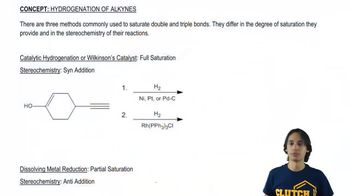
Step 4: For part (c), when pent-1-yne is treated with excess H2 in the presence of a nickel (Ni) catalyst, the alkyne undergoes complete hydrogenation. The triple bond is reduced to a single bond, and the product is pentane, a fully saturated alkane.
Step 5: Summarize the products: (a) vinyl chloride (C1=C2 with Cl on C2), (b) geminal dichloride (C1-C2 with two Cl atoms on C2), and (c) pentane (fully saturated alkane). These products are formed based on the reagents and reaction conditions provided.

비슷한 문제에 대한 검증된 영상 답변:

이 영상 해법은 위 문제에 도움이 된다고 튜터들이 추천한 것입니다.
영상 길이:
5m

주요 개념

질문에 올바르게 답하기 위해 반드시 이해해야 하는 핵심 개념들은 다음과 같습니다.

Alkyne Reactivity

Alkynes, such as pent-1-yne, are hydrocarbons containing a carbon-carbon triple bond. This triple bond makes them more reactive than alkenes and alkanes, allowing them to undergo various addition reactions. Understanding how alkynes react with electrophiles, such as HCl, is crucial for predicting the products of these reactions.
추천 영상:
09:11
Alkyne Hydration

Electrophilic Addition

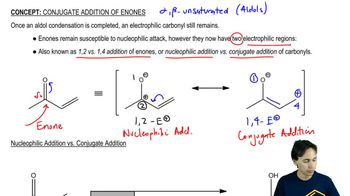
Electrophilic addition is a key reaction mechanism in organic chemistry where an electrophile reacts with a nucleophile, leading to the formation of a more stable product. In the case of alkynes reacting with HCl, the triple bond acts as a nucleophile, attacking the electrophilic hydrogen, resulting in the formation of a vinyl halide or a geminal dihalide, depending on the amount of HCl used.
추천 영상:
09:23
1,2 vs 1,4 Addition

Hydrogenation

Hydrogenation is the process of adding hydrogen (H2) to unsaturated hydrocarbons, such as alkynes, to convert them into saturated hydrocarbons. When pent-1-yne is treated with excess H2 in the presence of a catalyst like nickel (Ni), the triple bond is fully reduced to a single bond, resulting in the formation of pentane. This concept is essential for understanding how to manipulate the saturation of organic compounds.
추천 영상:
00:48
The definition of hydrogenation.