Benzyl bromide is a primary halide. It undergoes SN1 substitution about as fast as most tertiary halides. Use resonance structures to explain this enhanced reactivity.
Ch.6 - Alkyl Halides; Nucleophilic Substitution
6장, 문제 23c,d
Choose the member of each pair that will react faster by the SN1 mechanism.
c. n-propyl bromide or allyl bromide
d. 1-bromo-2,2-dimethylpropane or 2-bromopropane
검증된 단계별 안내1
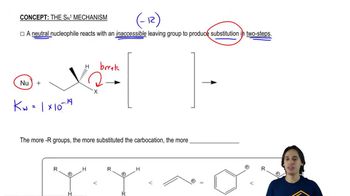
Step 1: Recall the key factors that influence the SN1 reaction rate. The SN1 mechanism involves the formation of a carbocation intermediate, so the stability of the carbocation is the most critical factor. More stable carbocations form faster, leading to a faster reaction.
Step 2: Analyze the first pair: n-propyl bromide and allyl bromide. When n-propyl bromide undergoes ionization, it forms a primary carbocation, which is relatively unstable. In contrast, allyl bromide forms an allylic carbocation, which is stabilized by resonance. Resonance stabilization makes the allylic carbocation much more stable than the primary carbocation.
Step 3: Conclude for the first pair: Since the allylic carbocation is more stable due to resonance, allyl bromide will react faster via the SN1 mechanism compared to n-propyl bromide.
Step 4: Analyze the second pair: 1-bromo-2,2-dimethylpropane and 2-bromopropane. When 1-bromo-2,2-dimethylpropane ionizes, it forms a tertiary carbocation, which is highly stable due to inductive effects and hyperconjugation from the surrounding alkyl groups. On the other hand, 2-bromopropane forms a secondary carbocation, which is less stable than a tertiary carbocation.
Step 5: Conclude for the second pair: Since the tertiary carbocation formed by 1-bromo-2,2-dimethylpropane is more stable, it will react faster via the SN1 mechanism compared to 2-bromopropane.

비슷한 문제에 대한 검증된 영상 답변:
이 영상 해법은 위 문제에 도움이 된다고 튜터들이 추천한 것입니다.
영상 길이:
5m주요 개념
질문에 올바르게 답하기 위해 반드시 이해해야 하는 핵심 개념들은 다음과 같습니다.
SN1 Mechanism
The SN1 mechanism is a type of nucleophilic substitution reaction that proceeds in two steps: the formation of a carbocation intermediate followed by nucleophilic attack. The rate of the reaction depends primarily on the stability of the carbocation formed. More stable carbocations, such as tertiary or allylic ones, will lead to faster reactions.
추천 영상:
Drawing the SN1 Mechanism
Carbocation Stability
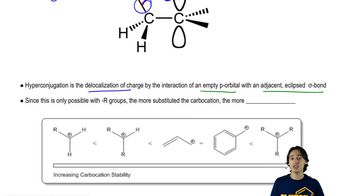
Carbocation stability is crucial in determining the rate of SN1 reactions. Carbocations are stabilized by hyperconjugation and inductive effects from adjacent alkyl groups. Tertiary carbocations are the most stable, followed by secondary and primary. Allylic carbocations, which can delocalize charge through resonance, are also relatively stable.
추천 영상:
Determining Carbocation Stability
Substituent Effects
The nature of substituents on the carbon atom bearing the leaving group influences the reaction rate. Electron-donating groups can stabilize the carbocation, while steric hindrance can impede the formation of the carbocation. In the context of the given pairs, the structure of the alkyl groups attached to the leaving group (bromide) will determine which compound reacts faster via the SN1 mechanism.
추천 영상:
가이드 코스
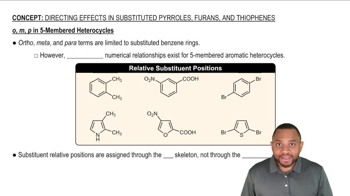
Directing Effects in Substituted Pyrroles, Furans, and Thiophenes Concept 1
관련 실천
교과서 질문
1856
views
교과서 질문
Propose an SN1 mechanism for the solvolysis of 3-bromo-2,3-dimethylpentane in ethanol.
2856
views
교과서 질문
Draw a perspective structure or a Fischer projection for the products of the following SN2 reactions.
(f)
959
views
교과서 질문
3-Bromocyclohexene is a secondary halide. It undergoes SN1 substitution about as fast as most tertiary halides. Use resonance structures to explain this enhanced reactivity.
2000
views
교과서 질문
Choose the member of each pair that will react faster by the SN1 mechanism.
e. 2-iodo-2-methylbutane or tert-butyl chloride
f. 2-bromo-2-methylbutane or ethyl iodide
1114
views
교과서 질문
Choose the member of each pair that will react faster by the SN1 mechanism.
a. 1-bromopropane or 2-bromopropane
b. 2-bromo-2-methylbutane or 2-bromo-3-methylbutane
1680
views