Propose an SN1 mechanism for the solvolysis of 3-bromo-2,3-dimethylpentane in ethanol.
Ch.6 - Alkyl Halides; Nucleophilic Substitution
6장, 문제 20e
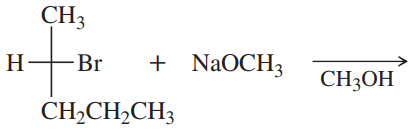
Draw a perspective structure or a Fischer projection for the products of the following SN2 reactions.
(e) 
검증된 단계별 안내1
Identify the type of reaction: This is an SN2 reaction, which involves a single-step mechanism where the nucleophile attacks the electrophilic carbon, displacing the leaving group in a backside attack. This results in inversion of configuration at the carbon center.
Analyze the reactants: The substrate is a secondary alkyl halide (2-bromobutane), and the nucleophile is methoxide ion (CH3O⁻) in methanol (CH3OH). Methoxide is a strong nucleophile, favoring the SN2 mechanism.
Determine the stereochemistry of the substrate: The carbon bonded to the bromine atom is a chiral center. In the given structure, the substituents are CH3, H, CH2CH2CH3, and Br. Assign the configuration (R or S) to this carbon using the Cahn-Ingold-Prelog priority rules.
Predict the product: In an SN2 reaction, the nucleophile (CH3O⁻) will attack the carbon from the side opposite to the leaving group (Br), leading to inversion of configuration. Draw the product with the methoxy group (OCH3) replacing the bromine atom and inverted stereochemistry at the chiral center.
Choose the representation: Draw the product as either a perspective structure (showing the 3D arrangement of groups) or a Fischer projection (a 2D representation where horizontal lines represent bonds coming out of the plane and vertical lines represent bonds going into the plane). Ensure the stereochemistry is correctly represented in the chosen format.

비슷한 문제에 대한 검증된 영상 답변:
이 영상 해법은 위 문제에 도움이 된다고 튜터들이 추천한 것입니다.
영상 길이:
1m주요 개념
질문에 올바르게 답하기 위해 반드시 이해해야 하는 핵심 개념들은 다음과 같습니다.
S<sub>N</sub>2 Mechanism
The S<sub>N</sub>2 mechanism is a type of nucleophilic substitution reaction where a nucleophile attacks an electrophile, resulting in the simultaneous displacement of a leaving group. This reaction occurs in a single concerted step, leading to the inversion of configuration at the carbon center. It is favored by primary and some secondary substrates due to steric accessibility.
추천 영상:
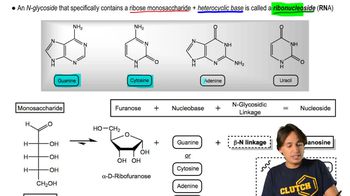
Creating Ribonucleosides
Fischer Projection
A Fischer projection is a two-dimensional representation of a three-dimensional organic molecule, particularly useful for depicting stereochemistry. In this format, vertical lines represent bonds that project away from the viewer, while horizontal lines represent bonds that project towards the viewer. Fischer projections are commonly used to illustrate the stereochemistry of carbohydrates and amino acids.
추천 영상:
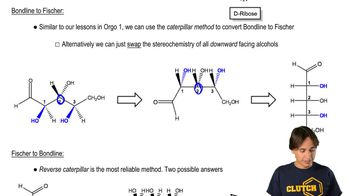
Monosaccharides - Drawing Fischer Projections
Nucleophiles and Electrophiles
Nucleophiles are species that donate an electron pair to form a chemical bond, while electrophiles are electron-deficient species that accept an electron pair. In S<sub>N</sub>2 reactions, the nucleophile attacks the electrophile, leading to the substitution of the leaving group. Understanding the nature of these species is crucial for predicting the outcome of organic reactions.
추천 영상:
Nucleophile or Electrophile
관련 실천
교과서 질문
2856
views
교과서 질문
For each pair of compounds, state which compound is the better SN2 substrate.
c. 2-bromobutane or isopropyl bromide
d. 1-chloro-2,2-dimethylbutane or 2-chlorobutane
e. 1-iodobutane or 2-iodopropane
1102
views
교과서 질문
Draw a perspective structure or a Fischer projection for the products of the following SN2 reactions.
(a) trans-1-bromo-3-methylcyclopentane + KOH
(b) (R)-2-bromopentane + KCN
1045
views
교과서 질문
Draw a perspective structure or a Fischer projection for the products of the following SN2 reactions.
(f)
959
views
교과서 질문
Draw a perspective structure or a Fischer projection for the products of the following SN2 reactions.
(c)
(d)
976
views
교과서 질문
Choose the member of each pair that will react faster by the SN1 mechanism.
a. 1-bromopropane or 2-bromopropane
b. 2-bromo-2-methylbutane or 2-bromo-3-methylbutane
1680
views