

Ch.6 - Alkyl Halides; Nucleophilic Substitution
Wade - Organic Chemistry 9th Edition
Wade9th EditionOrganic ChemistryISBN: 9780135213728당신이 사용하는 게 아니라요?교과서 변경
6장, 문제 3f

For each of the following compounds,
1. give the IUPAC name.
2. give the common name (if possible).
3. classify the compound as a methyl, primary, secondary, or tertiary halide.
(f) Structural representation of an alkyl halide with bromine and chlorine substituents attached to a carbon chain.

검증된 단계별 안내
1
Step 1: Analyze the structure provided in the image. The compound is a cyclobutane ring with two halogen substituents: bromine (Br) and chlorine (Cl). The substituents are attached to adjacent carbons in the ring.
Step 2: Assign locants to the substituents for the IUPAC name. Start numbering the ring from the carbon attached to bromine (Br) to give the lowest possible numbers to the substituents. Bromine is at position 1, and chlorine is at position 2.
Step 3: Write the IUPAC name. Combine the substituents in alphabetical order (bromine before chlorine) with their locants, followed by the parent chain name 'cyclobutane'. The IUPAC name is 1-bromo-2-chlorocyclobutane.
Step 4: Determine the common name (if possible). Since the compound does not have a widely recognized common name, the IUPAC name is typically used.
Step 5: Classify the halides. Bromine is attached to a secondary carbon (a carbon bonded to two other carbons), and chlorine is also attached to a secondary carbon. Therefore, both halides are secondary halides.

비슷한 문제에 대한 검증된 영상 답변:

이 영상 해법은 위 문제에 도움이 된다고 튜터들이 추천한 것입니다.
영상 길이:
3m

주요 개념

질문에 올바르게 답하기 위해 반드시 이해해야 하는 핵심 개념들은 다음과 같습니다.

IUPAC Nomenclature

IUPAC nomenclature is a systematic method for naming organic chemical compounds. It provides a set of rules to create unique names based on the structure of the molecule, including the longest carbon chain, functional groups, and substituents. Understanding these rules is essential for accurately identifying and communicating the identity of compounds.
추천 영상:
03:43
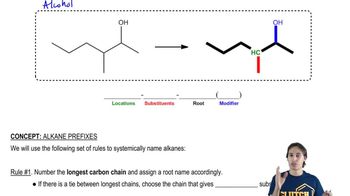
The different parts of an IUPAC name

Common Names

Common names are informal names used to identify chemical compounds, often based on historical or traditional usage rather than systematic rules. While IUPAC names are standardized, common names can vary by region and may not always reflect the compound's structure. Familiarity with common names can aid in recognizing widely used compounds in organic chemistry.
추천 영상:
06:06
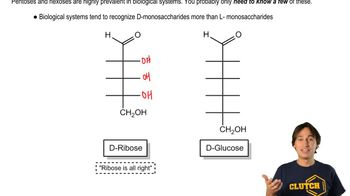
Monosaccharides - Common Structures

Classification of Halides

Halides are classified based on the carbon atom to which the halogen is attached. They can be categorized as methyl (attached to a methyl group), primary (attached to a primary carbon), secondary (attached to a secondary carbon), or tertiary (attached to a tertiary carbon). This classification is important for predicting reactivity and understanding the compound's behavior in chemical reactions.
추천 영상:
01:52
How to name alkyl halides