Ch.6 - Alkyl Halides; Nucleophilic Substitution
Wade - Organic Chemistry 9th Edition
Wade9th EditionOrganic ChemistryISBN: 9780135213728당신이 사용하는 게 아니라요?교과서 변경
6장, 문제 15e,f,g

Show how you might use SN2 reactions to convert 1-chlorobutane into the following compounds.
e. CH3—(CH2)3—C≡CH
f. CH3CH2—O—(CH2)3—CH3
g. CH3—(CH2)3—NH2

검증된 단계별 안내
1
Step 1: Begin with 1-chlorobutane (CH3—(CH2)3—Cl), which is a primary alkyl halide suitable for SN2 reactions due to minimal steric hindrance.
Step 2: For compound e (CH3—(CH2)3—C≡CH), use sodium acetylide (NaC≡CH) as the nucleophile. The acetylide ion will attack the carbon bonded to the chlorine in an SN2 reaction, replacing the chlorine with the acetylide group.
Step 3: For compound f (CH3CH2—O—(CH2)3—CH3), use sodium ethoxide (NaOCH2CH3) as the nucleophile. The ethoxide ion will perform an SN2 attack on the carbon bonded to chlorine, substituting the chlorine with the ethoxy group.
Step 4: For compound g (CH3—(CH2)3—NH2), use ammonia (NH3) as the nucleophile. Ammonia will attack the carbon bonded to chlorine in an SN2 reaction, replacing the chlorine with an amino group. Excess ammonia may be used to prevent over-alkylation.
Step 5: Ensure reaction conditions favor SN2 mechanisms by using polar aprotic solvents (e.g., acetone or DMSO) and maintaining low steric hindrance around the electrophilic carbon.

비슷한 문제에 대한 검증된 영상 답변:

이 영상 해법은 위 문제에 도움이 된다고 튜터들이 추천한 것입니다.
영상 길이:
6m

주요 개념

질문에 올바르게 답하기 위해 반드시 이해해야 하는 핵심 개념들은 다음과 같습니다.

SN2 Reactions

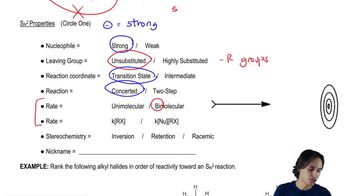
SN2 (Substitution Nucleophilic Bimolecular) reactions involve a nucleophile attacking an electrophilic carbon atom, resulting in the simultaneous displacement of a leaving group. This mechanism is characterized by a single concerted step, where the nucleophile approaches the carbon from the opposite side of the leaving group, leading to inversion of configuration. Understanding SN2 is crucial for predicting the outcomes of reactions involving primary alkyl halides like 1-chlorobutane.
추천 영상:
11:57
Understanding the properties of SN2.

Nucleophiles

Nucleophiles are species that donate an electron pair to form a chemical bond in a reaction. They are typically negatively charged or neutral molecules with lone pairs of electrons. In the context of SN2 reactions, strong nucleophiles are essential for effectively displacing the leaving group from the substrate. Examples include alkynes, alcohols, and amines, which can be derived from 1-chlorobutane through nucleophilic substitution.
추천 영상:
08:27
Nucleophilic Addition

Leaving Groups

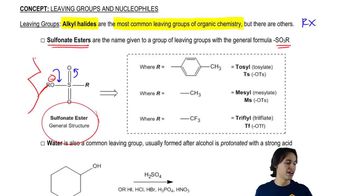
Leaving groups are atoms or groups that can depart from the substrate during a chemical reaction, allowing for the formation of new bonds. A good leaving group is typically stable after departure and can be a halide ion (like Cl- from 1-chlorobutane) or other groups such as tosylate or mesylate. The ability of a leaving group to stabilize its negative charge is critical in determining the feasibility of an SN2 reaction.
추천 영상:
07:22
The 3 important leaving groups to know.