Ch.6 - Alkyl Halides; Nucleophilic Substitution
Wade - Organic Chemistry 9th Edition
Wade9th EditionOrganic ChemistryISBN: 9780135213728당신이 사용하는 게 아니라요?교과서 변경
6장, 문제 43

Two of the carbocations in Problem 6-42 are prone to rearrangement. Show how they might rearrange to more stable ­carbocations.

검증된 단계별 안내
1
Step 1: Analyze the stability of the given carbocations. Carbocation 1 has a positive charge on a secondary carbon, while Carbocation 2 has a positive charge on a primary carbon. Both carbocations are prone to rearrangement to achieve greater stability.
Step 2: For Carbocation 1, consider a hydride shift (migration of a hydrogen atom with its bonding electrons) from the adjacent tertiary carbon. This will move the positive charge to the tertiary carbon, resulting in a more stable tertiary carbocation.
Step 3: For Carbocation 2, consider a methyl shift (migration of a methyl group with its bonding electrons) from the adjacent secondary carbon. This will move the positive charge to the secondary carbon, which is more stable than the primary carbocation.
Step 4: After the rearrangements, verify the new carbocations formed. Carbocation 1 should now have the positive charge on the tertiary carbon, and Carbocation 2 should have the positive charge on the secondary carbon.
Step 5: Understand the driving force behind these rearrangements. Stability increases as the carbocation moves from primary to secondary to tertiary due to hyperconjugation and inductive effects, which help delocalize the positive charge.

비슷한 문제에 대한 검증된 영상 답변:

이 영상 해법은 위 문제에 도움이 된다고 튜터들이 추천한 것입니다.
영상 길이:
10m

주요 개념

질문에 올바르게 답하기 위해 반드시 이해해야 하는 핵심 개념들은 다음과 같습니다.

Carbocation Stability

Carbocations are positively charged carbon species that can rearrange to achieve greater stability. The stability of carbocations increases with the degree of substitution: tertiary (3°) carbocations are more stable than secondary (2°), which are more stable than primary (1°). This stability is due to hyperconjugation and the inductive effect of alkyl groups, which help to disperse the positive charge.
추천 영상:
05:58
Determining Carbocation Stability

Rearrangement Mechanisms

Carbocation rearrangements typically occur through two main mechanisms: hydride shifts and alkyl shifts. In a hydride shift, a hydrogen atom moves from an adjacent carbon to the carbocation, while in an alkyl shift, an alkyl group moves to stabilize the positive charge. These shifts allow the carbocation to transform into a more stable form, often leading to the formation of a more substituted carbocation.
추천 영상:
06:08
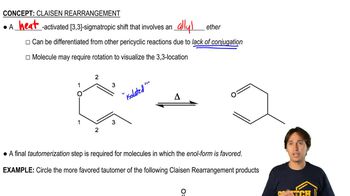
Definition of Claisen Rearrangement

Reaction Pathways

Understanding reaction pathways is crucial for predicting the outcome of carbocation rearrangements. The pathway involves the initial formation of a carbocation, followed by its rearrangement to a more stable carbocation, and finally, the reaction with a nucleophile. Analyzing the energy changes and intermediates along the pathway helps in determining the most favorable rearrangement and the final product.
추천 영상:
가이드 코스
1:08
Energy Production In Biochemical Pathways Example 1