Skip to main content
Personal Health
나의 코스
배우기
시험 준비
AI 튜터
학습 가이드
플래시카드
앱을 사용해 보세요
나의 코스
배우기
시험 준비
AI 튜터
학습 가이드
플래시카드
앱을 사용해 보세요
뒤로
Health Benefits of Exercise quiz
카드를 뒤집기 위해 탭할 수 있습니다.
What is the primary goal of exercise as defined in the lesson?
카드를 뒤집기 위해 탭할 수 있습니다.
👆
What is the primary goal of exercise as defined in the lesson?
The primary goal of exercise is to increase physical fitness through planned and repetitive physical activity.
진행 상황 추적
컨트롤 버튼이 '내비게이션' 모드로 변경되었습니다.
1/20
관련 플래시카드
관련 실천
추천 영상
Health Benefits of Exercise definitions
Health Benefits of Exercise
15 용어
Health Benefits of Exercise quiz #1
Health Benefits of Exercise
34 용어
Health Benefits of Exercise
Ch.7 Exercise and Fitness
5 문제점
주제
Nicole
Principles of Physical Training
Ch.7 Exercise and Fitness
5 문제점
주제
Ally
Ch.7 Exercise and Fitness
4 주제
12 문제점
장
Laura
VideoThumbView.guidedCourse
3:18
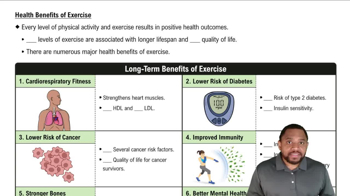
Health Benefits of Exercise Concept 1
101
views
2
rank
VideoThumbView.guidedCourse
2:02
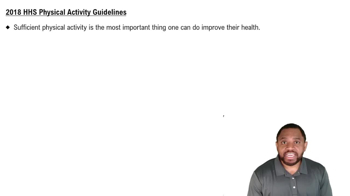
2018 HHS Physical Activity Guidelines Concept 2
66
views
1
rank
VideoThumbView.guidedCourse
1:20
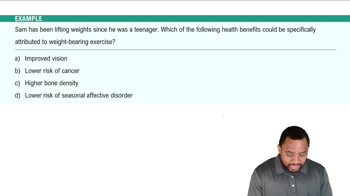
Health Benefits of Exercise Example 1
80
views
1
rank
이 집합의 용어 (20)
하이드의 정의
What is the primary goal of exercise as defined in the lesson?
The primary goal of exercise is to increase physical fitness through planned and repetitive physical activity.
How does any level of physical activity affect health outcomes?
Every level of physical activity results in positive health outcomes for the body.
What is associated with increasing levels of exercise?
Increasing levels of exercise are associated with longer lifespans and higher quality of life.
Name two long-term benefits of exercise related to disease prevention.
Exercise lowers the risk of type 2 diabetes and certain cancers.
How does exercise benefit cardiorespiratory fitness?
Exercise strengthens heart muscles, increases HDL (good cholesterol), and decreases LDL (bad cholesterol).
What effect does regular exercise have on type 2 diabetes risk?
Regular exercise decreases the risk of type 2 diabetes and increases insulin sensitivity.
How does exercise impact cancer risk and cancer survivors?
Exercise decreases several cancer risk factors and improves quality of life for cancer survivors.
What are two ways exercise improves immunity?
Exercise decreases inflammation and reduces the risk of upper respiratory infections.
How does weight-bearing exercise affect bone health?
Weight-bearing exercise helps build and maintain stronger bones, reducing the risk of osteoporosis.
What mental health benefits are associated with regular exercise?
Exercise improves cognitive function and helps decrease anxiety and depression.
According to the 2018 guidelines, how much moderate-intensity aerobic activity should adults do weekly?
Adults should engage in at least 150 minutes per week of moderate-intensity aerobic activity.
What is an alternative to 150 minutes of moderate-intensity aerobic activity per week?
Seventy-five minutes of vigorous-intensity aerobic activity or an equivalent combination can substitute.
How often should adults perform muscle-strengthening activities?
Adults should do muscle-strengthening activities two or more times per week.
What are examples of muscle-strengthening activities?
Examples include weight lifting, planks, and other weight-bearing exercises.
What is the recommendation regarding inactivity in the physical activity guidelines?
Everyone should avoid inactivity, as insufficient physical activity negatively impacts health.
What additional benefit is gained by doubling the recommended amount of physical activity?
Doubling the recommended activity provides more extensive benefits, including a lower risk of all-cause mortality.
What year was the second edition of the Physical Activity Guidelines for Americans published?
The second edition was published in 2018.
How does exercise affect cholesterol levels?
Exercise increases HDL (good cholesterol) and decreases LDL (bad cholesterol).
Why is it important to spend less time doing sedentary activities?
Spending less time sedentary has a huge positive impact on overall health.
How does exercise help with osteoporosis prevention?
Exercise, especially weight-bearing activities, helps maintain bone density and stave off osteoporosis.
 뒤로뒤로
뒤로뒤로


 3:18
3:18