 뒤로
Chapter 12 module
 15:52

이 집합의 용어 (25)
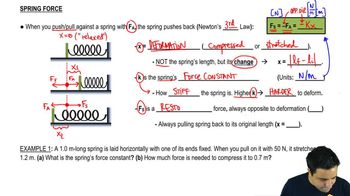
Hooke's Law is the ratio of force per distance stretched in an elastic material.
Elasticity is the property of a solid to change shape due to a deforming force and return to its original shape once the force is removed.
Iridium is the densest substance on Earth.
An insect has about 10 times as much surface area relative to its weight, reducing impact force.
Because a sphere has the smallest surface area per volume, minimizing material use and stress.
Weight density = \(\frac{\text{weight}}{\text{volume}}\)
Steel is very strong under tension forces.
It is called a dome.
Glass, plastic, and rubber are amorphous solids.
A solid with a random distribution of atoms.
Scaling studies how volume and shape affect strength, weight, and surface area relationships.
Compression is when something is pushed in or squashed.
As size increases, an object grows heavier much faster than it grows stronger.
Salt and quartz are examples of crystalline solids.
The elephant's ears are scaled large to enhance cooling.
The Gateway Arch in St. Louis, Missouri.
Density is the ratio of mass per unit volume.
Ionic, covalent, metallic, and molecular (Van der Waals) bonding.
Inelasticity is when materials do not resume their original shape after deformation.
Neither; both weigh the same.
A solid with an ordered arrangement of atoms.
A curve of maximum strength used in arches.
A chain hanging between two points of support forms a catenary curve.
Because flat stone slabs are weak under gravity forces and need support.
Tension is when something is pulled or stretched.