Skip to main content
Physics with Algebra
나의 코스
배우기
AI 튜터
학습 가이드
플래시카드
탐험해 보세요
앱을 사용해 보세요
나의 코스
배우기
AI 튜터
학습 가이드
플래시카드
탐험해 보세요
앱을 사용해 보세요
뒤로
Chapter 13 module
카드를 뒤집기 위해 탭할 수 있습니다.
What is the principle of flotation?
카드를 뒤집기 위해 탭할 수 있습니다.
👆
What is the principle of flotation?
A floating object displaces a weight of fluid equal to its own weight.
진행 상황 추적
컨트롤 버튼이 '내비게이션' 모드로 변경되었습니다.
1/24
추천 영상
VideoThumbView.guidedCourse
06:55
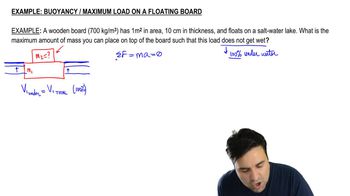
Maximum Load on Floating Board
83
views
VideoThumbView.guidedCourse
16:56
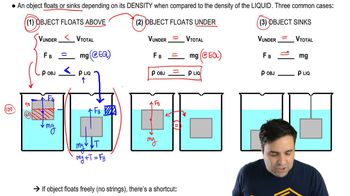
Buoyancy / Three Common Cases
154
views
VideoThumbView.guidedCourse
03:14
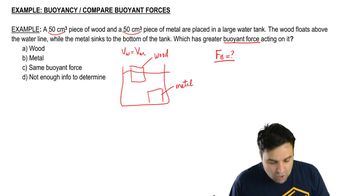
Comparing Buoyant Forces
138
views
이 집합의 용어 (24)
하이드의 정의
What is the principle of flotation?
A floating object displaces a weight of fluid equal to its own weight.
Who discovered the relationship between buoyancy and displaced liquid?
Archimedes, a 3rd-century BC Greek scientist.
What does total pressure in a fluid refer to?
The sum of atmospheric pressure and the pressure from the liquid.
Why does a thin layer of fat rise and float on cold soup in a refrigerator?
Because when the soup cools, the surface tension increases.
What buoyancy rule applies to a fish swimming in water?
The fish has a density equal to the density of the fluid it is immersed in.
On what two factors does the pressure in a liquid depend?
The depth of the submerged object and the density of the liquid.
Who discovered that pressure in a fluid is transmitted without loss?
Blaise Pascal, a 17th-century scientist.
What condition causes an object to sink in a fluid?
The object is denser than the fluid in which it is immersed.
What is adhesion?
The attraction of unlike materials to one another.
Name devices that rely on Pascal's principle.
Pumping stations, construction equipment, and automobile lifts.
What condition causes an object to float in a fluid?
The object is less dense than the fluid in which it is immersed.
What is the net upward force on an object submerged in a fluid called?
The buoyant force.
What causes the hairs on a paintbrush to stick together when pulled out of water?
Surface tension.
Where would a swimmer feel more pressure: 10 feet below a freshwater lake or a pool?
Neither; pressure depends only on depth, not the size of the body of water.
How compressible are liquids?
Liquids are practically incompressible.
What principle does a hydraulic lift in an automobile service station obey?
Pascal's principle.
When a stone is submerged in water, what volume of water does it displace?
A volume of water equal to the volume of the stone.
Why does pressure increase as you swim deeper in a lake?
Because pressure increases with depth.
Why is the net force on a submerged object upward?
Pressure is greater on the bottom of the object due to its depth.
What happens to water flow from holes at different depths in a bucket?
Water from the bottom hole spurts farthest; the top hole spurts the least.
What causes water to seep up hair into the scalp in a sink or bathtub?
Capillary action.
How does a boat's floating level change between salt water and fresh water?
A boat floats higher in fresh water than in salt water.
What is cohesion?
The attraction of like materials to one another.
Write the formula for pressure in terms of force and area.
Pressure = Force / Area, represented as \(P=\frac{F}{A}\).
 뒤로뒤로
 06:55