Ch. 02 - Describing Motion: Kinematics in One Dimension
Giancoli Douglas - Physics for Scientists and Engineers 5th edition
Giancoli Douglas5th editionPhysics for Scientists and EngineersISBN: 9780137488179당신이 사용하는 게 아니라요?교과서 변경
2장, 문제 97a

A parachutist bails out of an airplane, and freely falls 75 m (ignore air friction). Then the parachute opens, and her acceleration is ― 1.5 m/s² (up). The parachutist reaches the ground with a speed of 1.5 m/s. From how high did she bail out of the plane?

검증된 단계별 안내
1
Step 1: Break the problem into two phases: (1) free fall before the parachute opens, and (2) motion with the parachute open. Use kinematic equations to analyze each phase separately.
Step 2: For the free-fall phase, use the kinematic equation: vf2 = vi + 2gd, where vi is the initial velocity (0 m/s), g is the acceleration due to gravity (9.8 m/s²), and d is the distance fallen (75 m). Solve for the final velocity vf at the end of the free-fall phase.
Step 3: For the parachute phase, use the kinematic equation: vf = vi + at, where vf is the final velocity (1.5 m/s), vi is the velocity at the start of this phase (calculated in Step 2), a is the acceleration (-1.5 m/s²), and t is the time. Solve for the time t during this phase.
Step 4: Use the kinematic equation: d = vit + rac{1}{2}at2 to calculate the distance fallen during the parachute phase. Add this distance to the 75 m from the free-fall phase to find the total distance fallen.
Step 5: Add the total distance fallen to the final height above the ground (1.5 m/s corresponds to the final velocity just before landing). This gives the total height from which the parachutist bailed out of the plane.

비슷한 문제에 대한 검증된 영상 답변:

이 영상 해법은 위 문제에 도움이 된다고 튜터들이 추천한 것입니다.
영상 길이:
11m

주요 개념

질문에 올바르게 답하기 위해 반드시 이해해야 하는 핵심 개념들은 다음과 같습니다.

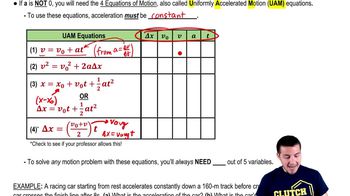
Kinematic Equations

Kinematic equations describe the motion of objects under constant acceleration. They relate displacement, initial velocity, final velocity, acceleration, and time. In this scenario, we can use these equations to determine the height from which the parachutist bailed out by considering her free fall and subsequent motion after the parachute opens.
추천 영상:
가이드 코스
08:25
Kinematics Equations

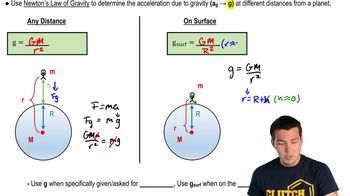
Acceleration due to Gravity

Acceleration due to gravity is the acceleration experienced by an object when it is in free fall near the Earth's surface, approximately 9.81 m/s² downward. In this problem, the parachutist falls freely for 75 m before the parachute opens, and understanding this acceleration is crucial for calculating the time of free fall and the height of the jump.
추천 영상:
가이드 코스
05:20
Acceleration Due to Gravity

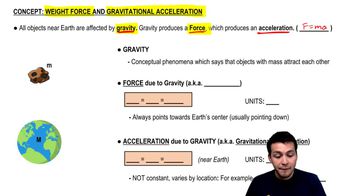
Net Force and Acceleration

The net force acting on an object determines its acceleration according to Newton's second law (F = ma). After the parachute opens, the parachutist experiences an upward acceleration of -1.5 m/s², indicating that the upward force from the parachute is less than the downward gravitational force. This concept is essential for analyzing the motion after the parachute deployment and calculating the total height of the fall.
추천 영상:
가이드 코스
07:32
Weight Force & Gravitational Acceleration