Ch. 08 - Conservation of Energy
Giancoli Douglas - Physics for Scientists and Engineers 5th edition
Giancoli Douglas5th editionPhysics for Scientists and EngineersISBN: 9780137488179당신이 사용하는 게 아니라요?교과서 변경
8장, 문제 73a

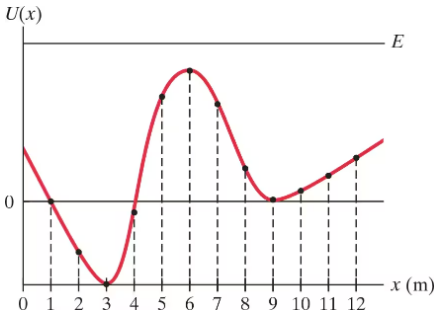
The graph of Fig. 8–43 shows the potential energy curve of a particle moving along the 𝓍 axis under the influence of a conservative force. Note that the total energy E > U(𝓍), so that the particle’s speed is never zero. In which interval(s) of 𝓍 is the force on the particle to the right?
Graph showing potential energy curve U(x) versus position x, with total energy E and intervals indicating force direction.

검증된 단계별 안내
1
Understand the relationship between force and potential energy: The force acting on a particle in a conservative field is related to the potential energy by the equation: F=-dUdx. This means the force is the negative gradient (slope) of the potential energy curve.
Analyze the slope of the potential energy curve: Look at the graph of the potential energy U(x). Identify the intervals where the slope of the curve is negative. A negative slope indicates that the force is positive (to the right).
Determine the intervals: For each interval of x, check whether the slope of the potential energy curve is negative. These intervals correspond to regions where the force is directed to the right.
Relate the total energy to the motion: Since the total energy E is greater than the potential energy U(x), the particle is always in motion. This ensures that the particle can move through all regions where the force is to the right.
Summarize the intervals: Based on the analysis of the graph, list the specific intervals of x where the force is directed to the right. These intervals are determined by the regions where the slope of U(x) is negative.

비슷한 문제에 대한 검증된 영상 답변:

이 영상 해법은 위 문제에 도움이 된다고 튜터들이 추천한 것입니다.
영상 길이:
2m

주요 개념

질문에 올바르게 답하기 위해 반드시 이해해야 하는 핵심 개념들은 다음과 같습니다.

Potential Energy and Conservative Forces

Potential energy is the energy stored in an object due to its position in a force field, such as gravitational or elastic forces. A conservative force is one where the work done is independent of the path taken and depends only on the initial and final positions. In this context, the potential energy curve indicates how the force acting on the particle changes with position along the x-axis.
추천 영상:
가이드 코스
06:43
Energy Conservation with Non-Conservative Forces

Total Energy and Motion

The total energy of a system is the sum of its kinetic and potential energy. When the total energy E is greater than the potential energy U(x), the particle has kinetic energy, meaning it is in motion. This relationship implies that the particle cannot be at rest (speed is never zero) in the regions where E > U(x), which is crucial for determining the intervals where the force acts.
추천 영상:
가이드 코스
04:54
Total Internal Energy

Force and Potential Energy Relationship

The force acting on a particle can be derived from the potential energy curve using the relationship F(x) = -dU/dx. This means that the force is related to the slope of the potential energy curve: if the slope is negative, the force is directed to the right, and if the slope is positive, the force is directed to the left. Analyzing the intervals of the potential energy curve helps identify where the force on the particle is directed.
추천 영상:
가이드 코스
03:43
Relationships Between Force, Field, Energy, Potential
관련 실천
교과서 질문

A driver notices that her 950-kg car, when in neutral, slows down from 95 km/h to 65 km/h in about 7.0 s on a flat horizontal road. Approximately what power (watts and hp) is needed to keep the car traveling at a constant 80 km/h?

1984
views

교과서 질문

An 85-kg football player traveling 5.0 m/s is stopped in 1.0 s by a tackler. What average power is required to stop him?

1699
views
교과서 질문

Water flows slowly over a dam at the rate of 320 kg/s and falls vertically 88 m before striking the turbine blades. Calculate the rate at which mechanical energy is transferred to the turbine blades, assuming 55% efficiency.

1632
views
교과서 질문

The potential energy of the two atoms in a diatomic (two-atom) molecule can be approximated as (Lennard-Jones potential) U(r) = -(a/r⁶) + (b/r¹²), where r is the distance between the two atoms and a and b are positive constants. At what values of r is U(r) a minimum? A maximum?

2012
views
교과서 질문

The graph of Fig. 8–43 shows the potential energy curve of a particle moving along the 𝓍 axis under the influence of a conservative force. Note that the total energy E > U(𝓍), so that the particle’s speed is never zero. At what value(s) of 𝓍 is the magnitude of the force a minimum?

1770
views
교과서 질문

The position of a 280-g object is given (in meters) by x = 4.0t³ - 8.0t² - 44t, where t is in seconds. What is the average net power input during the interval from t = 0s to t = 2.0 s, and in the interval from t = 2.0 s to 4.0 s?

2054
views