
Ch. 12 - Static Equilibrium; Elasticity and Fracture
Giancoli Douglas - Physics for Scientists and Engineers 5th edition
Giancoli Douglas5th editionPhysics for Scientists and EngineersISBN: 9780137488179당신이 사용하는 게 아니라요?교과서 변경
12장, 문제 51

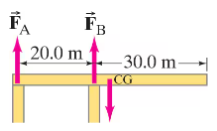
Assume the supports of the uniform cantilever shown in Fig. 12–79 (m = 2900 kg) are made of wood. Calculate the minimum cross-sectional area required of each, assuming a safety factor of 9.0.
Diagram of a uniform cantilever with forces and dimensions labeled, illustrating support reactions and load distribution.

검증된 단계별 안내
1
Determine the total weight of the cantilever by using the formula for weight: \( W = m \cdot g \), where \( m \) is the mass of the cantilever (2900 kg) and \( g \) is the acceleration due to gravity (9.8 m/s²).
Calculate the total force that each support must bear. Since the cantilever is uniform, the weight is evenly distributed, so each support will bear half of the total weight: \( F_{support} = \frac{W}{2} \).
Apply the safety factor to the force. The safety factor ensures the supports can handle more than the expected load. Multiply the force on each support by the safety factor: \( F_{safe} = F_{support} \cdot 9.0 \).
Use the formula for stress to relate the force to the cross-sectional area: \( \sigma = \frac{F}{A} \), where \( \sigma \) is the maximum allowable stress for wood (a material property that must be provided or looked up). Rearrange the formula to solve for the cross-sectional area: \( A = \frac{F_{safe}}{\sigma} \).
Substitute the values for \( F_{safe} \) and \( \sigma \) into the equation to calculate the minimum cross-sectional area required for each support. Ensure the units are consistent throughout the calculation.

비슷한 문제에 대한 검증된 영상 답변:

이 영상 해법은 위 문제에 도움이 된다고 튜터들이 추천한 것입니다.
영상 길이:
12m

주요 개념

질문에 올바르게 답하기 위해 반드시 이해해야 하는 핵심 개념들은 다음과 같습니다.

Cantilever Beam

A cantilever beam is a structural element that is fixed at one end and free at the other. It supports loads applied along its length, creating bending moments and shear forces. Understanding the behavior of cantilever beams is crucial for analyzing their strength and stability under various loading conditions.
추천 영상:
가이드 코스
13:40
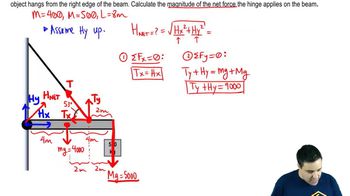
Beam supporting an object

Safety Factor

The safety factor is a design criterion that provides a margin of safety in engineering structures. It is defined as the ratio of the maximum load a structure can withstand to the intended load. A higher safety factor indicates greater reliability and is essential for ensuring that structures can handle unexpected loads or material defects.
추천 영상:
가이드 코스
15:52
Intro to Springs

Cross-Sectional Area

The cross-sectional area of a structural element is the area of its section perpendicular to its length. It is a critical factor in determining the strength and stiffness of materials under load. In the context of cantilevers, calculating the minimum cross-sectional area ensures that the supports can safely carry the weight and forces acting on the beam.
추천 영상:
가이드 코스
08:10
Calculating the Vector (Cross) Product Using Components
관련 실천
교과서 질문

The Leaning Tower of Pisa is 55 m tall and about 7.7 m in radius. The top is 4.5 m off center. Is the tower in stable equilibrium? If so, how much farther can it lean before it becomes unstable? Assume the tower is of uniform composition.

1564
views
교과서 질문

A steel cable is to support an elevator whose total (loaded) mass is not to exceed 3100 kg. If the maximum acceleration of the elevator is 1.8 m/s² , calculate the diameter of cable required. Assume a safety factor of 8.0.

1535
views
교과서 질문

The subterranean tension ring that surrounds the dome in Fig. 12–39 exerts the balancing horizontal force on the abutments for the dome and is 36-sided, so each segment makes a 10° angle with the adjacent one (Fig. 12–83). Calculate the tension F that must exist in each segment so that the required force of 4.2 x 10⁵ N can be exerted at each corner (Example 12–14).

1462
views
교과서 질문

A heavy load Mg = 62.0 kN hangs at point E of the single cantilever truss shown in Fig. 12–81. Use a torque equation for the truss as a whole to determine the tension FT in the support cable, and then determine the force FA→\(\overrightarrow{F_{A}\)} on the truss at pin A. Neglect the weight of the trusses, which is small compared to the load.

1353
views
1
rank
교과서 질문

A marble column of cross-sectional area 1.4m² supports a mass of 22,000 kg. By how much is the column shortened if it is 8.6 m high?

1795
views
교과서 질문

A 15-cm-long tendon was found to stretch 3.7 mm by a force of 13.4 N. The tendon was approximately round with an average diameter of 8.5 mm. Calculate Young’s modulus of this tendon.

70
views