

Ch. 18 - Kinetic Theory of Gases
Giancoli Douglas - Physics for Scientists and Engineers 5th edition
Giancoli Douglas5th editionPhysics for Scientists and EngineersISBN: 9780137488179당신이 사용하는 게 아니라요?교과서 변경
18장, 문제 7a

A 1.0-mol sample of helium gas has a temperature of 18°C. What is the total kinetic energy of all the gas atoms in the sample?

검증된 단계별 안내
1
Convert the given temperature from Celsius to Kelvin using the formula: \( T(K) = T(°C) + 273.15 \). For this problem, \( T = 18 + 273.15 \).
Recall the formula for the total kinetic energy of an ideal gas: \( KE_{total} = \frac{3}{2} nRT \), where \( n \) is the number of moles, \( R \) is the ideal gas constant (8.314 J/(mol·K)), and \( T \) is the temperature in Kelvin.
Substitute the given values into the formula: \( n = 1.0 \) mol, \( R = 8.314 \) J/(mol·K), and \( T \) (calculated in step 1). The equation becomes \( KE_{total} = \frac{3}{2} (1.0)(8.314)(T) \).
Simplify the expression by multiplying the constants \( \frac{3}{2} \times 8.314 \) and then multiplying by the temperature \( T \) in Kelvin.
The result of the calculation will give the total kinetic energy of all the gas atoms in the sample, expressed in joules (J).

비슷한 문제에 대한 검증된 영상 답변:

이 영상 해법은 위 문제에 도움이 된다고 튜터들이 추천한 것입니다.
영상 길이:
4m

주요 개념

질문에 올바르게 답하기 위해 반드시 이해해야 하는 핵심 개념들은 다음과 같습니다.

Kinetic Energy of Gases

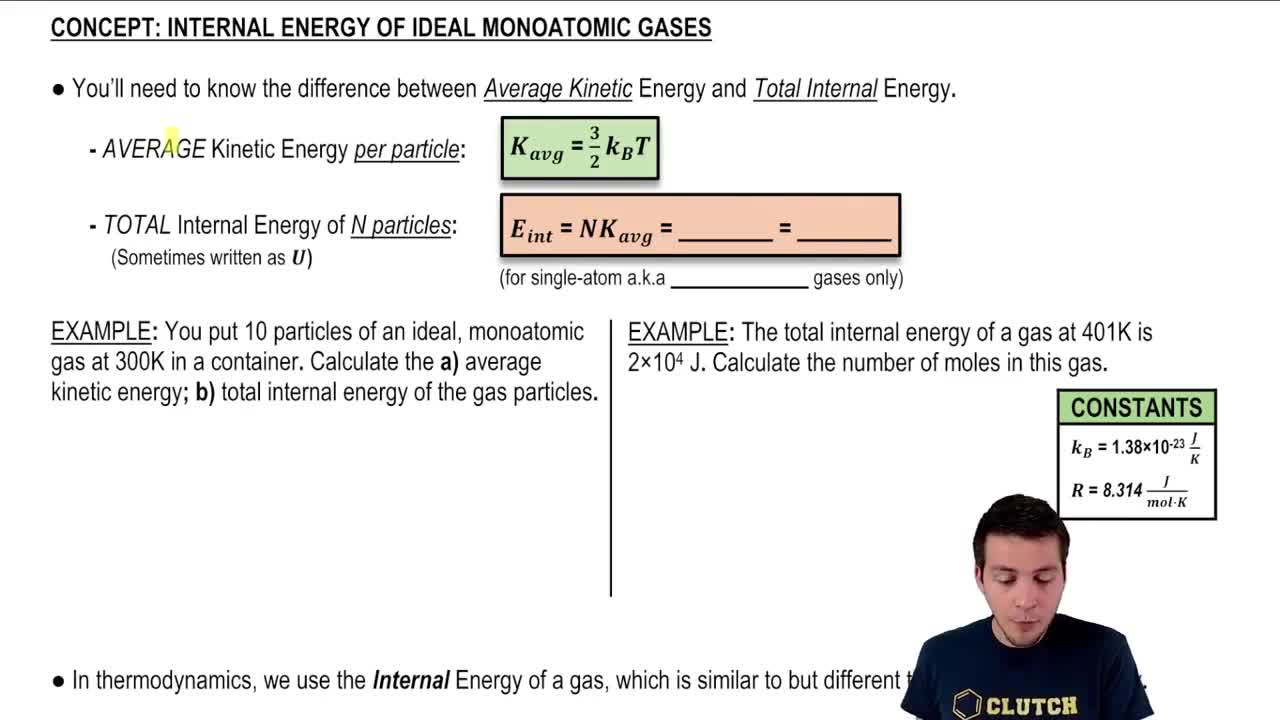
The kinetic energy of gas particles is directly related to their temperature. For an ideal gas, the average kinetic energy per particle can be calculated using the formula KE = (3/2)kT, where k is the Boltzmann constant and T is the temperature in Kelvin. This relationship indicates that as temperature increases, the kinetic energy of the gas particles also increases.
추천 영상:
가이드 코스
06:12
Internal Energy of Ideal Monoatomic Gases

Ideal Gas Law

The Ideal Gas Law, represented as PV = nRT, relates the pressure (P), volume (V), and temperature (T) of an ideal gas to the number of moles (n) and the ideal gas constant (R). While this law is not directly used to calculate kinetic energy, it provides a framework for understanding the behavior of gases under various conditions, which is essential for thermodynamic calculations.
추천 영상:
가이드 코스
07:21
Ideal Gases and the Ideal Gas Law

Molar Mass and Moles

Molar mass is the mass of one mole of a substance, typically expressed in grams per mole. In this question, the sample of helium gas is given as 1.0 mol. Understanding moles is crucial for calculating the total kinetic energy, as it allows us to determine the total number of gas atoms and subsequently apply the kinetic energy formula to find the total energy of the sample.
추천 영상:
가이드 코스
07:19
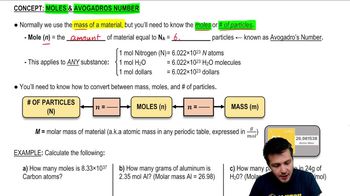
Moles & Avogadro's Number