The temperature within the Earth’s crust increases about 1.0 C° for each 30 m of depth. The thermal conductivity of the crust is 0.80 J/s C°. Determine the heat transferred from the interior to the surface for the entire Earth in 1.0 h.
Ch. 19 - Heat and the First Law of Thermodynamics
Giancoli Douglas5th editionPhysics for Scientists and EngineersISBN: 9780137488179당신이 사용하는 게 아니라요?교과서 변경
19장, 문제 99d
Calculate what will happen when 1000 J of heat is added to 100 grams of water at 100°C.
검증된 단계별 안내1
Step 1: Identify the key concepts involved in the problem. Here, the problem involves heat transfer, phase change, and the specific heat of water. Since the water is already at 100°C, any additional heat will go into changing the phase of water from liquid to vapor (boiling), not increasing its temperature.
Step 2: Recall the formula for heat transfer during a phase change: , where is the heat added, is the mass of the substance, and is the latent heat of vaporization. For water, the latent heat of vaporization is approximately .
Step 3: Convert the mass of water from grams to kilograms if necessary. In this case, the mass is already given in grams (), so no conversion is needed.
Step 4: Use the formula to determine how much of the water will vaporize. Rearrange the formula to solve for the mass of water vaporized: . Substitute and into the equation.
Step 5: Calculate the result to determine how much of the 100 grams of water will vaporize. If the heat provided is insufficient to vaporize all the water, the remaining water will stay in liquid form. Ensure the units are consistent throughout the calculation.

비슷한 문제에 대한 검증된 영상 답변:
이 영상 해법은 위 문제에 도움이 된다고 튜터들이 추천한 것입니다.
영상 길이:
2m주요 개념
질문에 올바르게 답하기 위해 반드시 이해해야 하는 핵심 개념들은 다음과 같습니다.
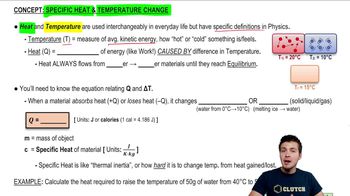
Specific Heat Capacity
Specific heat capacity is the amount of heat required to raise the temperature of a unit mass of a substance by one degree Celsius. For water, this value is approximately 4.18 J/g°C. Understanding this concept is crucial for calculating temperature changes when heat is added or removed from a substance.
추천 영상:
가이드 코스
Specific Heat & Temperature Changes
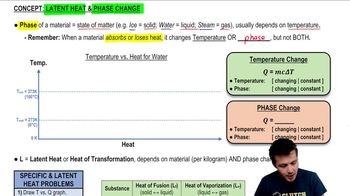
Phase Changes
Phase changes occur when a substance transitions between solid, liquid, and gas states, often involving significant energy transfer without a temperature change. For water, adding heat at 100°C can lead to boiling, where the temperature remains constant while the water changes from liquid to vapor, requiring additional energy known as the latent heat of vaporization.
추천 영상:
가이드 코스
Latent Heat & Phase Changes
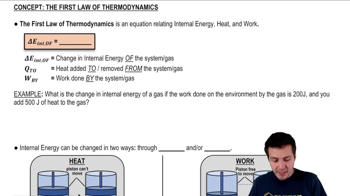
Thermodynamics
Thermodynamics is the branch of physics that deals with heat, work, and energy transfer. It encompasses laws that describe how energy is conserved and transformed. In this context, understanding the first law of thermodynamics helps explain how the added heat affects the water's temperature and phase, ensuring energy conservation throughout the process.
추천 영상:
가이드 코스
The First Law of Thermodynamics
관련 실천
교과서 질문
906
views
교과서 질문
A leaf of area 40cm² and mass 4.5 x 10⁻⁴ kg directly faces the Sun on a clear day. The leaf has an emissivity of 0.85 and a specific heat of 0.80 kcal/kgK. Estimate the energy absorbed per second by the leaf from the Sun.
929
views
교과서 질문
Calculate what will happen when 1000 J of heat is added to 100 grams of ice at -20°C.
1072
views
교과서 질문
A 12-g lead bullet traveling at 220 m/s passes through a thin wall and emerges at a speed of 160 m/s. If the bullet absorbs 50% of the heat generated, If the bullet’s initial temperature was 20°C, will any of the bullet melt, and if so, how much?
886
views
교과서 질문
Metabolizing 1.0 kg of fat results in about 3.7 x 10⁷ J of internal energy in the body. How long would it take to burn 1.0 kg of fat this way assuming there is no food intake?
508
views
