Ch. 19 - Heat and the First Law of Thermodynamics
Giancoli Douglas - Physics for Scientists and Engineers 5th edition
Giancoli Douglas5th editionPhysics for Scientists and EngineersISBN: 9780137488179당신이 사용하는 게 아니라요?교과서 변경
19장, 문제 30

A 55-g bullet traveling at 250 m/s penetrates a block of ice at 0°C and comes to rest within the ice. Assuming that the temperature of the bullet doesn’t change appreciably, how much ice is melted as a result of the collision?

검증된 단계별 안내
1
Step 1: Calculate the initial kinetic energy of the bullet using the formula for kinetic energy: Kinitial = (1/2) m v2 , where m is the mass of the bullet (55 g converted to kg) and v is its velocity (250 m/s).
Step 2: Convert the kinetic energy into heat energy, assuming all the kinetic energy is transferred to the ice. The heat energy is equal to the initial kinetic energy of the bullet.
Step 3: Use the heat energy to calculate the mass of ice melted. The heat required to melt ice is given by Q = m Lf , where Lf is the latent heat of fusion for ice (334,000 J/kg). Rearrange the formula to solve for m , the mass of ice melted: m = Q / Lf .
Step 4: Substitute the value of the heat energy (from Step 2) and the latent heat of fusion into the formula to find the mass of ice melted.
Step 5: Ensure the units are consistent throughout the calculation (e.g., mass in kilograms, energy in joules) and interpret the result to determine how much ice is melted.

주요 개념

질문에 올바르게 답하기 위해 반드시 이해해야 하는 핵심 개념들은 다음과 같습니다.

Kinetic Energy

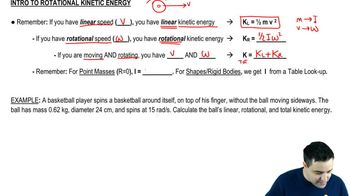
Kinetic energy is the energy possessed by an object due to its motion, calculated using the formula KE = 1/2 mv², where m is mass and v is velocity. In this scenario, the bullet's kinetic energy before impact is converted into heat energy upon colliding with the ice, leading to the melting of the ice.
추천 영상:
가이드 코스
06:07
Intro to Rotational Kinetic Energy

Heat of Fusion

The heat of fusion is the amount of energy required to change a substance from solid to liquid at its melting point without changing its temperature. For ice, this value is approximately 334,000 J/kg. Understanding this concept is crucial for calculating how much ice melts as a result of the energy transferred from the bullet.
추천 영상:
가이드 코스
05:14
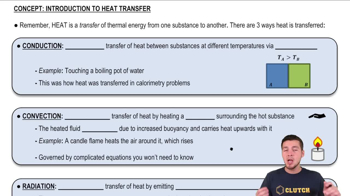
Overview of Heat Transfer

Conservation of Energy

The principle of conservation of energy states that energy cannot be created or destroyed, only transformed from one form to another. In this problem, the kinetic energy of the bullet is transformed into thermal energy, which is then used to melt the ice, illustrating this fundamental concept in physics.
추천 영상:
가이드 코스
06:24
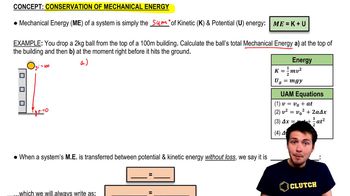
Conservation Of Mechanical Energy
관련 실천
교과서 질문

Show, using Eqs. 19–7 and 19–16, that the work done by a gas that slowly expands adiabatically from pressure P₁ and volume V₁ , to P₂ and V₂, is given by W = (P₁V₁ - P₂V₂) / (γ - 1).

1079
views
교과서 질문

An iron boiler of mass 180 kg contains 710 kg of water at 18°C. A heater supplies energy at the rate of 58,000 kJ/h. How long does it take for the water to all have changed to steam?

656
views
교과서 질문

At a crime scene, the forensic investigator notes that the 6.2-g lead bullet that was stopped in a doorframe apparently melted completely on impact. Assuming the bullet was shot at room temperature (20°C), what does the investigator calculate as the minimum muzzle velocity of the gun?

783
views
교과서 질문

If a heater supplies 1.8 x 10⁶ J/h to a room 3.5 m x 4.6 m x 3.0 m containing air at 20°C and 1.0 atm, by how much will the temperature rise in one hour, assuming no losses of heat or air mass to the outside? Assume air is an ideal diatomic gas with molecular mass 29.

1142
views
교과서 질문

A 1.0-L volume of air initially at 3.5 atm of (gauge)pressure is allowed to expand isothermally until the (gauge) pressure is 1.0 atm. It is then compressed at constant pressure to its initial volume, and lastly is brought back to its original pressure by heating at constant volume. How much work does the 1.0 L of air do in this process?

1517
views
교과서 질문

Determine the latent heat of fusion of mercury using the following calorimeter data: 1.00 kg of solid Hg at its melting point of −39.0°C is placed in a 0.620-kg aluminum calorimeter with 0.400 kg of water at 12.80°C; the resulting equilibrium temperature is 5.06°C.

923
views