Ch. 19 - Heat and the First Law of Thermodynamics
Giancoli Douglas - Physics for Scientists and Engineers 5th edition
Giancoli Douglas5th editionPhysics for Scientists and EngineersISBN: 9780137488179당신이 사용하는 게 아니라요?교과서 변경
19장, 문제 19.31

(II) A cube of ice is taken from the freezer at -8.5°C and placed in an 85-g aluminum calorimeter filled with 310 g of water at room temperature of 20.0°C. The final situation is all water at 17.0°C. What was the mass of the ice cube?

검증된 단계별 안내
1
Calculate the heat lost by the water and the calorimeter. Use the formula \(Q = mc\Delta T\), where \(m\) is the mass, \(c\) is the specific heat capacity (for water, \(c = 4.18 \, \text{J/g}^{\circ}\text{C}\) and for aluminum, \(c = 0.900 \, \text{J/g}^{\circ}\text{C}\)), and \(\Delta T\) is the change in temperature.
Calculate the heat gained by the ice to raise its temperature from -8.5°C to 0°C using the same heat formula. For ice, use the specific heat capacity \(c = 2.09 \, \text{J/g}^{\circ}\text{C}\).
Calculate the heat required to melt the ice at 0°C. Use the formula $Q = mL$, where \(m\) is the mass of the ice and \(L\) is the latent heat of fusion for ice (\(L = 334 \, \text{J/g}\)).
Set up the equation where the total heat lost by the water and the calorimeter equals the total heat gained by the ice. This includes the heat to raise the temperature of the ice to 0°C and the heat to melt the ice.
Solve the equation for the mass of the ice, \(m_{\text{ice}}\). This will give you the mass of the ice cube initially placed in the calorimeter.

비슷한 문제에 대한 검증된 영상 답변:

이 영상 해법은 위 문제에 도움이 된다고 튜터들이 추천한 것입니다.
영상 길이:
11m

주요 개념

질문에 올바르게 답하기 위해 반드시 이해해야 하는 핵심 개념들은 다음과 같습니다.

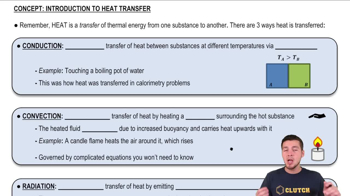
Heat Transfer

Heat transfer is the process by which thermal energy moves from one object to another due to a temperature difference. In this scenario, heat flows from the warmer water and aluminum calorimeter to the colder ice cube, causing the ice to melt and the water to cool down until thermal equilibrium is reached.
추천 영상:
가이드 코스
05:14
Overview of Heat Transfer

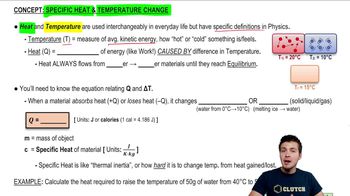
Specific Heat Capacity

Specific heat capacity is the amount of heat required to raise the temperature of a unit mass of a substance by one degree Celsius. Each material has a unique specific heat capacity, which influences how much energy is absorbed or released during temperature changes. In this problem, the specific heat capacities of water and aluminum are crucial for calculating the heat exchanges.
추천 영상:
가이드 코스
06:50
Specific Heat & Temperature Changes

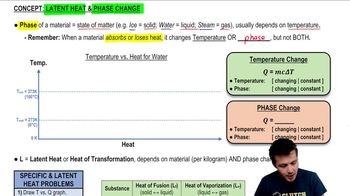
Phase Change

Phase change refers to the transition of a substance from one state of matter to another, such as from solid to liquid. During the melting of ice, energy is absorbed without a change in temperature until the ice completely transitions to water. This latent heat of fusion must be accounted for when determining the mass of the ice cube in the calorimetry problem.
추천 영상:
가이드 코스
10:40
Latent Heat & Phase Changes