The position of a particle as a function of time is given by = ( 5.0î +4.0ĵ )t² m where t is in seconds. What is the particle's speed at t = 0, 2, and 5 s?
Ch 03: Vectors and Coordinate Systems
3장, 문제 22c
Let , and . Find the magnitude and the direction of .
검증된 단계별 안내1
Break each vector into its components. For vector A, calculate the x-component as A_x = A * cos(20°) and the y-component as A_y = -A * sin(20°) (negative because it is south of east). For vector B, since it points directly north, its x-component is B_x = 0 and its y-component is B_y = B. For vector C, calculate the x-component as C_x = -C * cos(70°) (negative because it is west) and the y-component as C_y = -C * sin(70°) (negative because it is south).
Add the x-components of all three vectors to find the x-component of D: D_x = A_x + B_x + C_x.
Add the y-components of all three vectors to find the y-component of D: D_y = A_y + B_y + C_y.
Calculate the magnitude of vector D using the Pythagorean theorem: |D| = sqrt(D_x^2 + D_y^2).
Determine the direction of vector D by calculating the angle θ using the formula θ = arctan(D_y / D_x). Adjust the angle based on the signs of D_x and D_y to ensure it is in the correct quadrant.

비슷한 문제에 대한 검증된 영상 답변:
이 영상 해법은 위 문제에 도움이 된다고 튜터들이 추천한 것입니다.
영상 길이:
7m주요 개념
질문에 올바르게 답하기 위해 반드시 이해해야 하는 핵심 개념들은 다음과 같습니다.
Vector Addition
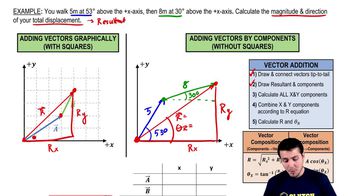
Vector addition involves combining multiple vectors to find a resultant vector. This process requires breaking each vector into its components, typically along the x (horizontal) and y (vertical) axes. The components are then summed separately to obtain the total x and y components of the resultant vector.
추천 영상:
가이드 코스
Vector Addition By Components
Trigonometric Functions
Trigonometric functions, such as sine and cosine, are essential for resolving vectors into their components based on their angles. For a vector at an angle θ, the x-component can be found using the cosine function (A_x = A * cos(θ)), and the y-component using the sine function (A_y = A * sin(θ)). This allows for accurate calculations of vector magnitudes and directions.
추천 영상:
가이드 코스
Intro to Wave Functions
Magnitude and Direction of a Vector
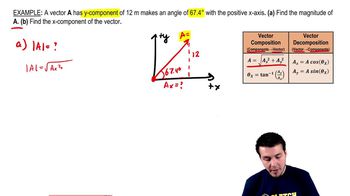
The magnitude of a vector represents its length or size, while the direction indicates the angle at which it acts. After calculating the resultant vector's components, the magnitude can be found using the Pythagorean theorem (|D| = √(D_x² + D_y²)), and the direction can be determined using the arctangent function (θ = arctan(D_y / D_x)), which gives the angle relative to a reference axis.
추천 영상:
가이드 코스
Calculating Magnitude & Components of a Vector
관련 실천
교과서 질문
2136
views
교과서 질문
Let = (5.0 m, 30 degrees counterclockwise from vertically up). Find the x- and y-components of in each of the two coordinate systems shown in FIGURE EX3.21.
2773
views
교과서 질문
The position of a particle as a function of time is given by = ( 5.0î +4.0ĵ )t² m where t is in seconds. Find an expression for the particle's velocity as a function of time.
2820
views
교과서 질문
The position of a particle as a function of time is given by = ( 5.0î +4.0ĵ )t² m where t is in seconds. What is the particle's distance from the origin at t = 0, 2, and 5 s?
1943
views
교과서 질문
FIGURE EX3.19 shows vectors A and B. What is C = A + B? Write your answer in component form using unit vectors.
2137
views
1
rank
교과서 질문
What are the x- and y-components of the velocity vector shown in FIGURE EX3.20?
3060
views