
Ch 09: Work and Kinetic Energy
Knight Calc - Physics for Scientists and Engineers 5th Edition
Knight Calc5th EditionPhysics for Scientists and EngineersISBN: 9780137344796당신이 사용하는 게 아니라요?교과서 변경
9장, 문제 63c

A Porsche 944 Turbo has a rated engine power of 217 hp. 30% of the power is lost in the engine and the drive train, and 70% reaches the wheels. The total mass of the car and driver is 1480 kg, and two-thirds of the weight is over the drive wheels. How long does it take the Porsche to reach the maximum power output?

검증된 단계별 안내
1
Step 1: Convert the engine power from horsepower (hp) to watts (W). Use the conversion factor: 1 hp = 746 W. Multiply the given engine power (217 hp) by 746 W/hp to find the power in watts.
Step 2: Calculate the power that reaches the wheels. Since 70% of the engine power reaches the wheels, multiply the total power in watts by 0.7 to find the effective power at the wheels.
Step 3: Determine the force exerted by the drive wheels. Use the relationship between power, force, and velocity: \( P = F \cdot v \). At maximum power output, the velocity \( v \) is the instantaneous velocity of the car. Rearrange the formula to solve for force: \( F = \frac{P}{v} \).
Step 4: Calculate the acceleration of the car. Use Newton's second law \( F = m \cdot a \), where \( m \) is the mass of the car and driver (1480 kg). Rearrange to solve for acceleration: \( a = \frac{F}{m} \).
Step 5: Determine the time required to reach maximum power output. Use the kinematic equation \( v = a \cdot t \), where \( v \) is the velocity at maximum power output, \( a \) is the acceleration, and \( t \) is the time. Rearrange to solve for time: \( t = \frac{v}{a} \).

비슷한 문제에 대한 검증된 영상 답변:

이 영상 해법은 위 문제에 도움이 된다고 튜터들이 추천한 것입니다.
영상 길이:
11m

주요 개념

질문에 올바르게 답하기 위해 반드시 이해해야 하는 핵심 개념들은 다음과 같습니다.

Power and Efficiency

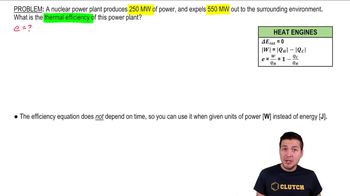
Power in physics is the rate at which work is done or energy is transferred. In the context of the Porsche 944 Turbo, the engine's rated power of 217 hp indicates its maximum output. However, efficiency plays a crucial role, as 30% of this power is lost due to engine and drivetrain inefficiencies, meaning only 70% is available for acceleration.
추천 영상:
가이드 코스
03:55
Efficiency of a Nuclear Power Plant

Kinematics and Acceleration

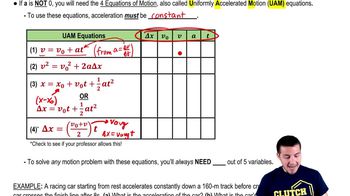
Kinematics is the branch of mechanics that deals with the motion of objects without considering the forces that cause the motion. To determine how long it takes for the Porsche to reach maximum power output, one must analyze its acceleration, which can be calculated using the net force acting on the car and its mass. The relationship between force, mass, and acceleration is described by Newton's second law, F = ma.
추천 영상:
가이드 코스
08:25
Kinematics Equations

Weight Distribution and Traction

Weight distribution affects a vehicle's traction and handling. In this case, two-thirds of the Porsche's total weight is over the drive wheels, which enhances grip and allows for better acceleration. Understanding how weight affects traction is essential for calculating the effective force available for acceleration, as it influences the frictional force between the tires and the road.
추천 영상:
가이드 코스
10:19
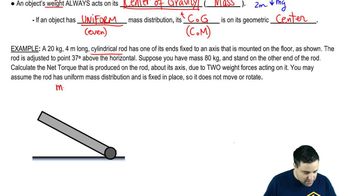
Torque Due to Weight
관련 실천
교과서 질문

Astronomers using a 2.0-m-diameter telescope observe a distant supernova - an exploding star. The telescope's detector records 9.1 x 10⁻¹¹ J of light energy during the first 10 s. It's known that this type of supernova has a visible-light power output of 5.0 x 1037 W for the first 10 s of the explosion. How distant is the supernova? Give your answer in light years, where one light year is the distance light travels in one year. The speed of light is 3.0 x 10⁸ m/s.

2251
views
교과서 질문

When you ride a bicycle at constant speed, nearly all the energy you expend goes into the work you do against the drag force of the air. Model a cyclist as having cross-section area 0.45 m² and, because the human body is not aerodynamically shaped, a drag coefficient of 0.90. Use 1.2 kg/m³ as the density of air at room temperature. The food calorie is equivalent to 4190 J. How many calories does the cyclist burn if he rides over level ground at 7.3 m/s for 1 h?

1899
views
교과서 질문

Write a realistic problem for which this is the correct equation(s).

T−(1500kg)(9.8m/s2)=(1500kg)(1.0m/s2)T-(1500\,\(\text{kg}\))(9.8\,\(\text{m/s}\)^2)=(1500\,\(\text{kg}\))\(\left\)(1.0\,\(\text{m/s}\)^2\(\right\))

P=T(2.0m/s)P=T(2.0\,\(\text{m/s}\))

1907
views
교과서 질문

A Porsche 944 Turbo has a rated engine power of 217 hp. 30% of the power is lost in the engine and the drive train, and 70% reaches the wheels. The total mass of the car and driver is 1480 kg, and two-thirds of the weight is over the drive wheels. If the Porsche accelerates at amax, what is its speed when it reaches maximum power output?

2035
views
교과서 질문

A farmer uses a tractor to pull a 150 kg bale of hay up a 15° incline to the barn at a steady 5.0 km/h. The coefficient of kinetic friction between the bale and the ramp is 0.45. What is the tractor's power output?

2173
views
교과서 질문

A Porsche 944 Turbo has a rated engine power of 217 hp. 30% of the power is lost in the engine and the drive train, and 70% reaches the wheels. The total mass of the car and driver is 1480 kg, and two-thirds of the weight is over the drive wheels. What is the maximum acceleration of the Porsche on a concrete surface where μs = 1.00? Hint: What force pushes the car forward?

3177
views